.jpg)

Across the Pond, a Shared Incentive Strategy Emerges But Europe and the US Take Different Paths to Impact Measurement
 This article compares the findings of two Incentive Research Foundation reports over the last year on the practices of top performing companies in the US and Europe.
 A Common Foundation: Strategy, Alignment, and Leadership
Where the Paths Diverge: Flexibility vs. Focus
Measurement as a Dividing Line
Toward a Blended Model of Engagement
Click here to subscribe to RRN weekly, and here for an RRN media kit.
Two major new studies from the Incentive Research Foundation—one focused on Europe and the other on the United States—arrive at a strikingly similar conclusion: top-performing organizations have fundamentally redefined incentives, rewards and recognition as strategic tools for driving performance, culture, and growth. Yet beneath that alignment lies a meaningful divergence in how these programs are designed, measured, and optimized. European firms distinguish themselves through discipline and focus—particularly in measurement and high-value experiences—while US organizations lead in flexibility, scalability, and integrated program design. Together, they outline a combined model that may point to the future of incentive program design.
This article compares two studies:
- 2026 European Top Performers Study: This is based on a survey conducted December 2025–January 2026 among incentive travel decision-makers at European companies with €100 million ($116 million) or more in revenue. Participants were 450 full-time professionals with significant influence over incentive travel, rewards, and recognition programs.
- 2025 US Top Performers Study: This is based on a survey of 600 US-based reward and recognition decision-makers at companies with $100 million or more in revenue, conducted in 2025.
- Achieving significant revenue growth over the previous year.
- Expanding their total customer base over the previous year.
- Increasing their employee base over the previous year.
- Considering themselves successful in meeting key performance goals (financial, growth, etc.) acquiring new customers and retaining existing ones.
A Common Foundation: Strategy, Alignment, and Leadership 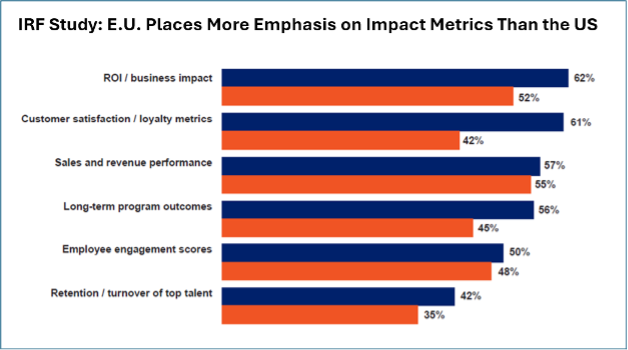
What stands out first is how much the two regions agree. In both Europe and the US, top performing companies begin with alignment. Programs are intentionally designed to reflect company values, reinforce strategic priorities, and drive specific business outcomes—from revenue growth to talent retention. Leadership support is not optional; it is foundational. In both studies, top-performing organizations report near-universal executive backing, along with stronger internal resources and cross-functional collaboration.
This shared architecture signals a clear shift in the field. The days of isolated recognition programs are fading. In their place are integrated systems designed with purpose, supported from the top, and embedded across the organization.
Where the Paths Diverge: Flexibility vs. Focus
The differences begin to emerge in how these strategies are brought to life. US organizations tend to build expansive, flexible reward ecosystems. They combine travel, merchandise, gift cards, and points-based systems, allowing participants multiple ways to engage and earn. These programs are designed to scale across large, diverse populations, emphasizing personalization and accessibility.
European organizations take a more concentrated approach. Based on the survey, their programs—particularly incentive travel—are designed to deliver fewer but more meaningful experiences. Top performers qualify a smaller percentage of participants but invest more heavily in each reward, emphasizing exclusivity, emotional impact, and alignment with brand identity. Both approaches are effective, but they reflect different philosophies: one prioritizes reach and flexibility, the other depth and intensity.
Measurement as a Dividing Line
Perhaps the most consequential difference lies in measurement. European top performers stand apart for their rigor. They more consistently track ROI, business performance, customer outcomes, and long-term impact—and they do so with confidence. Measurement is not an afterthought; it is a defining capability that shapes program design and justifies investment.US organizations, while certainly aware of the need for measurement, place comparatively greater emphasis on design innovation and program reach. The focus is often on creating compelling experiences and flexible systems, with measurement playing a supporting role rather than serving as the central differentiator, the survey indicates. This distinction has important implications. As pressure grows to demonstrate tangible business impact, the European model may offer a preview of where the broader field is heading.
Toward a Blended Model of Engagement
Taken together, these studies do not point to competing approaches but to complementary strengths. European companies demonstrate the power of discipline—clear alignment, focused investment, rigorous measurement, and continuous optimization. US organizations show how flexibility, personalization, and scale can broaden engagement and sustain participation across complex organizations.
The opportunity for leaders is not to choose between these models, but to combine them. Imagine programs that are as measurable as those in Europe, yet as flexible and inclusive as those in the United States. Systems that deliver both emotional impact and enterprise-wide reach. Strategies that are not only aligned and well-supported, but continuously refined based on real data. That is the direction these studies suggest—and the standard the next generation of engagement programs will likely be judged against.
Enterprise Engagement Alliance Services
Celebrating our 15th year, the Enterprise Engagement Alliance helps organizations enhance performance through:
1. Information and marketing opportunities on stakeholder management and total rewards:
ESM Weekly on stakeholder management since 2009; click here for a media kit.
RRN Weekly on total rewards since 1996; click here for a EEA YouTube channel on enterprise engagement, human capital, and total rewards insights and how-to information since 2020.
2. Learning: Purpose Leadership and Stakeholder
 Management Academy to enhance future equity value and performance for your organization.
3. Books on implementation: Enterprise Engagement for CEOs and Enterprise Engagement: The Roadmap.
4. Advisory services and research: Strategic guidance, learning and certification on stakeholder management, measurement, metrics, and corporate sustainability reporting.
5. Permission-based targeted business development to identify and build relationships with the people most likely to buy.
6. Public speaking and meeting facilitation on stakeholder management. The world’s leading speakers on all aspects of stakeholder management across the enterprise.