

Behavioral Science Explains Motivation But Are Incentive Programs Designed That Way
.jpeg) This Incentive Research Foundation white paper provides more evidence that most incentive, reward, and recognition providers have little background in the behavioral economic factors that can drive engagement design.
This Incentive Research Foundation white paper provides more evidence that most incentive, reward, and recognition providers have little background in the behavioral economic factors that can drive engagement design.
Click here to subscribe to RRN weekly, and here for an RRN media kit.
A new research brief by Allan Schweyer, Chief Academic Advisor to the Incentive Research Foundation highlights how cognitive biases—such as present bias, loss aversion, social comparison, and hedonic adaptation—shape how employees respond to incentives and recognition. Drawing on decades of behavioral economics and psychology research, the paper shows why reward timing, framing, and perceived fairness can strongly influence program outcomes.
The larger question raised by the research is whether corporations and the incentive, rewards, and recognition (IRR) solution providers that serve them are systematically applying these insights when designing programs. How many incentive and recognition practitioners build these research considerations into program design.
 Behavioral science has transformed how economists and psychologists understand motivation and decision-making. Yet it remains unclear whether these insights are consistently applied in the design of incentive and recognition programs used by corporations and the providers that develop them. The new report by Allan Schweyer summarizes a range of behavioral economics and organizational psychology findings showing how cognitive biases influence how employees perceive and respond to rewards.
Among the key behavioral dynamics highlighted is present bias, the tendency for individuals to place greater value on immediate rewards than on those delivered in the future. Another is loss aversion, a central concept developed by psychologists Daniel Kahneman of Princeton University and Amos Tversky of Stanford University and Hebrew University, showing that people experience losses more strongly than equivalent gains. Their landmark paper, “Prospect Theory: An Analysis of Decision Under Risk," reshaped modern economic thinking about decision-making.
The research also points to the importance of hedonic adaptation, in which the motivational impact of rewards diminishes over time as people become accustomed to them, and social comparison, where employees evaluate recognition and rewards relative to those received by peers. Behavioral economist Richard Thaler of the University of Chicago, whose work on mental accounting earned him the Nobel Prize in Economic Sciences, has also shown that non-cash rewards such as travel or merchandise can produce disproportionate motivational impact because they occupy a distinct psychological category and create lasting social and emotional memories.
Taken together, the research suggests that effective incentive and recognition programs depend not only on the value of rewards but also on how they are framed, timed, and perceived within a social context. Programs that delay rewards too long, create overly complex rules, or fail to account for social comparison can inadvertently weaken motivation rather than strengthen it.
The broader implication, however, may be less about whether the science exists than whether it is consistently applied. Corporations invest billions annually in incentives, rewards, and recognition, while solution providers continually introduce new platforms, merchandise offerings, and experiential rewards. Yet relatively little evidence suggests that behavioral research is systematically integrated into program design or measurement. If the research summarized by the IRF is correct, the industry’s greatest opportunity may lie not in expanding the range of rewards, but in applying the science of human motivation more rigorously to how these programs are structured, promoted, and measured.
Enterprise Engagement Alliance Services
 Celebrating our 15th year, the Enterprise Engagement Alliance helps organizations enhance performance through:
1. Information and marketing opportunities on stakeholder management and total rewards:
ESM Weekly on stakeholder management since 2009; click here for a media kit.
RRN Weekly on total rewards since 1996; click here for a EEA YouTube channel on enterprise engagement, human capital, and total rewards insights and how-to information since 2020.
2. Learning: Purpose Leadership and Stakeholder
 Management Academy to enhance future equity value and performance for your organization.
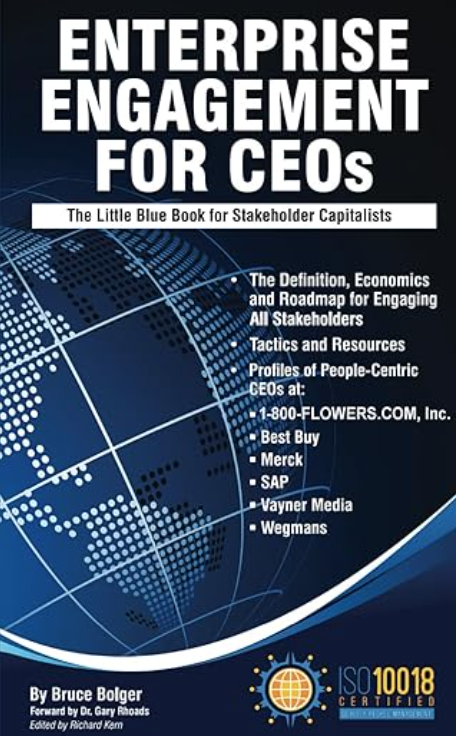
3. Books on implementation: Enterprise Engagement for CEOs and Enterprise Engagement: The Roadmap.
4. Advisory services and research: Strategic guidance, learning and certification on stakeholder management, measurement, metrics, and corporate sustainability reporting.
5. Permission-based targeted business development to identify and build relationships with the people most likely to buy.
6. Public speaking and meeting facilitation on stakeholder management. The world’s leading speakers on all aspects of stakeholder management across the enterprise.