.jpg)

Enterprise Engagement Alliance Impact Academy Earns SHRM Recertification Provider Status
A Strategic Approach to Stakeholder Engagement Across the Enterprise
The Relevance to HR and All Leaders
A Missing Discipline in Management Education
 Recertification Provider, enabling HR professionals to earn Professional Development Credits (PDCs) through the EEA certification program. To earn this role, the EEA had to demonstrate the alignment of its education program with SHRM’s commitment to support “the behavioral competencies, skills, and HR knowledge professionals need to effectively lead people, support organizational success, and advance their careers in human resources.”
Engagement is every manager's responsibility. The program is designed not only for management in HR but for all front-line managers.
As a recent SHRM article notes, even the best engagement strategies fail when managers lack the skills to translate organizational intent into daily employee experiences. The EEA Impact Academy was created to address exactly this challenge by providing a practical framework for aligning leadership, management, and stakeholder engagement around measurable business outcomes.
Launched in 2009, the Enterprise Engagement Alliance Impact Academy is the only known certification and executive education program focused on applying Total Quality Management (TQM) principles to people. It teaches leaders, managers, HR, sales, marketing, and operations professionals and front-line managers how to systematically align employees, customers, partners, and other stakeholders around a common purpose, goals, and values to achieve measurable business results. Unlike traditional engagement, recognition, or leadership programs, the Academy provides a practical, standards-based framework for designing, implementing, measuring, and continuously improving engagement as a source of value creation and competitive advantage.
Explains Bruce Bolger, Founder of the EEA, "While SHRM offers excellent programs in employee engagement, culture, total rewards, analytics, and leadership, the EEA Impact Academy focuses on how these disciplines can be aligned and integrated into a single stakeholder engagement framework designed to improve organizational performance. Developed well before the concept of stakeholder management now widely discussed in HR, it brings practices long proven in TQM to fhe field of people management.
EEA Impact Academy Academic Director is Gary Rhoads, Professor Emeritus, Marketing and Entrepreneurship at the Marriott School of Business at Brigham Young University, and founder of three start-ups related to people engagement. Human Capital Analytics Advisor is Darwin Hanson, CEO, Founder TM Evolution, a compensation, total rewards, and human capital analytics firm with a SaaS based process for applying statistical process controls to people management and marketing.
A Strategic Approach to Stakeholder Engagement Across the Enterprise
The program is designed to help HR professionals strengthen competencies in leadership, communication, business acumen, consultation, organizational effectiveness, and stakeholder engagement.
The EEA's long-term vision is to help establish stakeholder engagement as a recognized management disciplines in the same
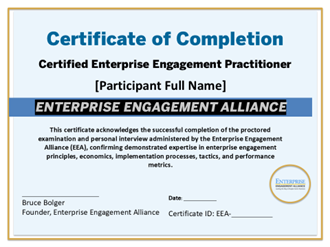 way TQM has became an accepted framework for improving quality and operational performance.
The goal is not to replace existing HR, leadership, customer experience, or organizational development practices. Rather, it is to provide a common framework that helps organizations harmonize these disciplines around a shared objective at the front lines: creating sustainable value through people. The SHRM Recertification Provider designation represents an important milestone toward that vision and provides further recognition of the growing need for practical, measurable approaches to human capital and stakeholder engagement.
For HR professionals seeking new tools to address today's workplace challenges, it also provides access to educational programs that connect engagement principles directly to business results—an objective that lies at the heart of both the EEA mission and the SHRM BASK (Body of Applied Skills and Knowledge) framework.
Here are two quick anonymous assessment tools to test one's knowledge on engagement strategies, systems, and tools and level of understanding of basic principles covered in the certification.
- Private Assessment of Capabilities in the Design and Implementation of Enterprise Engagement Strategies. No registration involved. This is a completely anonymous tool to evaluate the capabilities of solution providers presenting recognition and engagement solutions to your firm.
- Quick Private Practice Test for Enterprise Engagement Academy Certification. No registration involved. This enables you to quickly assess the level of knowledge you have about enterprise engagement design, implementation and metrics.
The Relevance to HR and All Leaders
The expectations placed on HR and all leaders continue to expand. Organizations increasingly look to HR not only to administer programs but also to
 improve retention, productivity, culture, customer experience, leadership effectiveness, innovation, and organizational resilience at the front-lines of management.
Meeting those expectations requires more than individual programs or initiatives. It requires systems that align people and processes around organizational objectives. The EEA's educational programs are designed to help leaders at every level understand how those systems work and how to measure their impact.
The SHRM Recertification Provider designation gives HR professionals and front-line managers an additional opportunity to explore these concepts while earning credits toward maintaining their SHRM credentials.
While SHRM does not endorse independent recertification programs, of significance to all HR professionals is that this certification demonstrates that the enterprise engagement framework aligns with SHRM's Body of Applied Skills and Knowledge (BASK), which serves as the foundation for SHRM certification and professional development.
The SHRM BASK emphasizes both behavioral competencies and technical HR expertise required for effective organizational leadership. EEA educational programs reinforce many of these same competencies, including:
• Relationship Management through techniques for engaging employees, customers, suppliers, and other stakeholders around shared goals.
• Communication through structured approaches to feedback, collaboration, recognition, and organizational alignment.
• Leadership and navigation by helping professionals understand how to create cultures that support organizational performance and continuous improvement.
• Consultation by providing tools and frameworks for diagnosing engagement challenges and developing practical solutions.
• Business acumen through a focus on connecting people strategies to organizational objectives, financial performance, customer outcomes, and operational results.
• Analytical aptitude through the use of measurement, metrics, benchmarking, and continuous improvement methodologies.
While the designation provides an important benefit for SHRM-certified professionals seeking recertification credits, it also reflects a broader trend in the profession. As organizations face persistent challenges related to engagement, retention, culture, productivity, and leadership effectiveness, HR professionals are increasingly looking for practical frameworks that connect people strategies directly to organizational performance, increasingly known as stakeholder HR, a term coined by Dave Ulrich, a Professor of Human Resources at the University of Michigan and a profilfic author and innovator in HR management. The program is specifically designed to help HR professionals and other leaders strengthen competencies in leadership, communication, business acumen, consultation, organizational effectiveness, and stakeholder engagement.
The EEA was founded on a simple premise: organizations cannot optimize value creation for shareholders without systematically engaging the stakeholders who create that value—employees, customers, distribution and supply chain partners, and communities. For decades, management thinkers have promoted concepts such as stakeholder capitalism, human capital management, employee engagement, customer experience, purpose, and culture.
Yet despite growing awareness of their importance, employee engagement levels remain stubbornly low and many organizations struggle to connect people initiatives to measurable business outcomes.
The EEA's educational programs seek to address that challenge by providing a practical framework for engaging people in organizational success through a process of continuous improvement.
A Missing Discipline in Management Education
One of the EEA's central observations is that while most organizations invest heavily in leadership training, recognition programs, employee experience initiatives, and culture-building efforts, relatively few professionals are taught how to integrate these practices into a coherent management system. The EEA Impact Academy was created to help fill that gap.
Participants learn how to align organizational purpose, goals, metrics, communications, learning, recognition, rewards, and feedback systems in ways that support measurable outcomes at every level of leadership, from the board to the front-line manager. The curriculum extends beyond employee engagement to include customers, distribution partners, suppliers, and communities, reflecting the growing recognition that organizational success depends upon the engagement of all stakeholders.
The approach provides leaders at every level with practical tools that can be applied regardless of industry, function, or organizational size.