

Global IRR Market Shows Regional Differences But the Same Measurement Gap
North America: Broadest Market and Strongest Sales and Channel Incentive Bench
Europe: Benefits, Perks, Loyalty, and Promotions Technology
APAC and Emerging Markets: Hybrid, Digital, Mobile, and Cross-Border
What the Regional Differences Suggest
What Is Similar Across All Regions
The Opportunity for the Next Stage of the Market
Click here to subscribe to the ESM weekly e-newsletter.
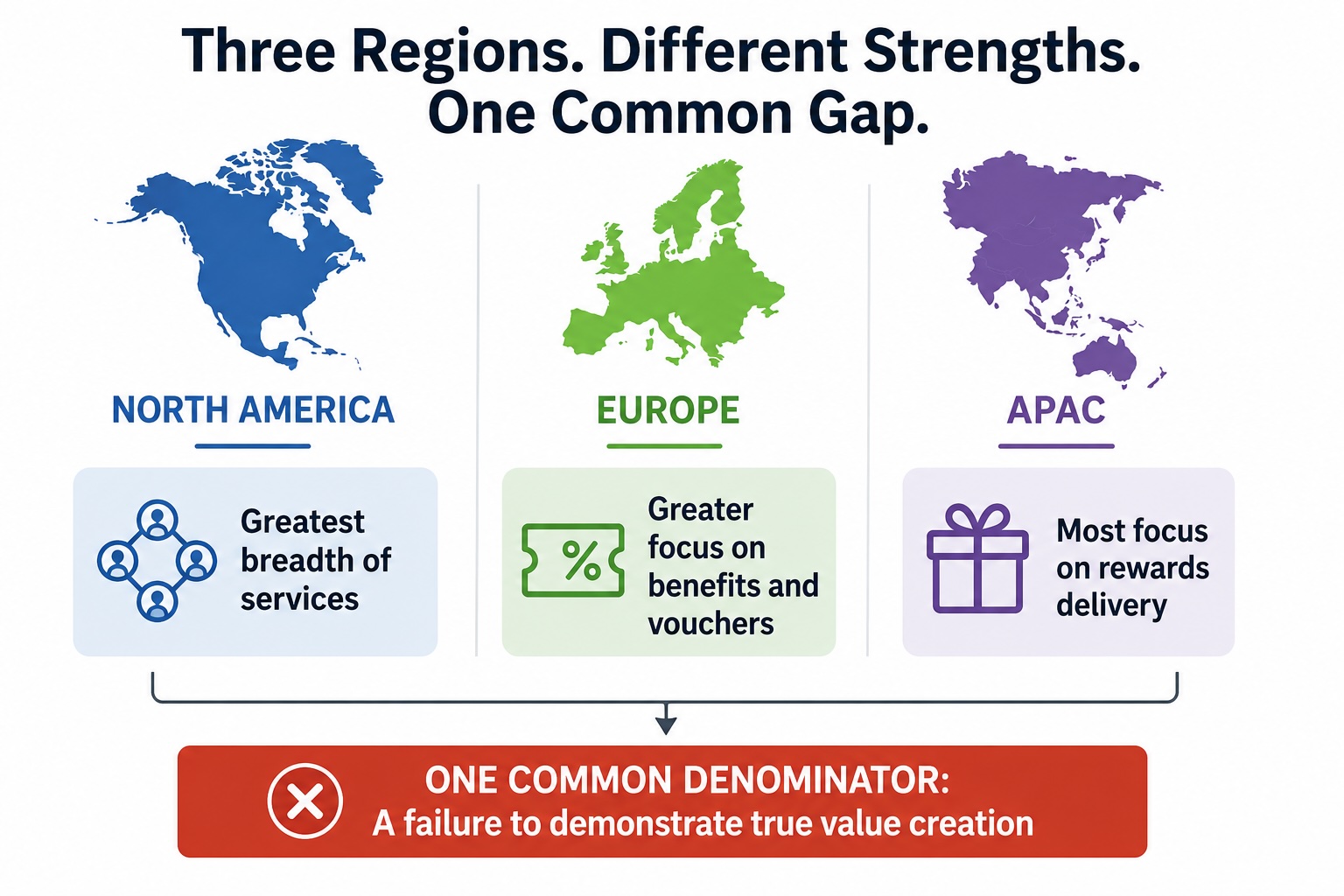 A review of over 160 incentive, rewards, recognition, loyalty, gifting, benefits, and engagement companies suggests that North America has the broadest performance-incentive market, Europe has the strongest benefits and loyalty technology orientation, and APAC and emerging markets are more hybrid, digital, and rewards-platform driven. The two segments that appears to show the strongest direct engagement from corporate end-users are loyalty and motivational events, with much less visible corporate engagement in recognition and almost none in traditional incentives.
The global incentive, rewards, recognition, and loyalty marketplace is not one uniform industry. It is a set of regional ecosystems shaped by employment traditions, consumer behavior, benefit structures, tax issues, technology adoption, and the maturity of sales, channel, loyalty, and recognition programs. A review of the nearly 170 ESM/RRN global list of known IRR providers, combined with spot checks of representative company websites, suggests clear differences among North America, Europe, and APAC/emerging markets. The more important similarity, however, is that most companies still focus on what they sell—recognition, rewards, incentives, loyalty, benefits, gift cards, gifting, travel, or fulfillment—rather than on measurable business outcomes.
One additional distinction stands out: among all these categories, loyalty and motivational events appear to have the most visible engagement from corporate end-users. Customer loyalty attracts direct participation from brands, retailers, financial services companies, hospitality companies, airlines, restaurants, and other organizations that view loyalty as central to customer retention, frequency, lifetime value, and revenue. Motivational events attracts large number of corporate meeting and incentive travel planners. Recognition appears to have far less visible senior corporate engagement, often remaining inside HR or employee experience circles. Traditional incentives—especially sales and channel incentives—appear to have the least direct corporate end-user engagement, despite their potential connection to measurable business outcomes.
North America: Broadest Market and Strongest Sales and Channel Incentive Bench
North America appears to have the largest and most diverse mix of providers. The region includes employee recognition companies, service award firms, sales and channel incentive agencies, incentive travel companies, customer loyalty providers, reward fulfillment platforms, gift card companies, employee experience platforms, enterprise and gifting technology companies, and a smaller number of strategy-led performance improvement firms.
In employee recognition and culture, companies such as Workhuman, O.C. Tanner, Achievers, Awardco, Terryberry, WorkPoud, WorkTango, Bonusly, Motivosity, Assembly, Nectar HR, and Kudos illustrate the region’s strong recognition and employee experience orientation. North America also has the deepest concentration of sales, channel, incentive travel, and performance incentive firms. BI WORLDWIDE, Maritz, ITA Group, One10 Marketing, Next-Level Performance, Motivation Excellence, Hinda Incentives, Incentco, Extu, Xceleration, and Creative Group are examples of companies that address sales, channel, customer, travel, recognition, or reward programs in various combinations.
Customer loyalty is also represented, sometimes as a stand-alone discipline and sometimes embedded within broader incentive or engagement firms. Companies such as Kangaroo, Brandmovers, Cora Loyalty, Engage People, Rymax, Gapp Group, and Access Development are examples of North American loyalty or loyalty-related providers. Other companies, including BI WORLDWIDE, Maritz, CarltonOne, Augeo, and ITA Group, include loyalty as part of broader employee, channel, customer, or reward strategies.
The North American market’s strength is breadth. It has more companies that can address sales incentives, channel incentives, recognition, loyalty, reward fulfillment, and incentive travel. Its weakness is fragmentation. Many of these capabilities are still presented as separate product lines rather than as parts of an integrated engagement system.
The engagement gap is especially revealing. Loyalty appears to attract the most direct attention from corporate end-users because it is tied to customer data, repeat purchasing, retention, and revenue. The motivational events business also attracts many corporate practitioners. Recognition has visible vendor and HR engagement, but less evidence of broad senior management or cross-functional corporate involvement. Incentives, despite their close connection to sales and channel performance, appear to generate the least visible corporate end-user engagement in the broader marketplace.
The IRR industry's leading conference, the upcoming IMA Summit increasingly appears to be a marketplace for the gift cards, technology and infrastructure that power rewards. An analysis of approximately 409 identifiable attendees representing more than 200 organizations indicates that gift card, stored-value, payment and digital reward-delivery companies account for about 43% of attendance. Traditional incentive and loyalty companies represent approximately 18%, while recognition and employee-engagement providers account for another 10%.
| IMA Summit Primary company category | Approx. share of attendees |
| Gift cards, stored value, payments and reward delivery | 43% |
| Incentive, loyalty and performance marketing | 18% |
| Recognition and employee engagement | 10% |
| Technology and specialized platforms | 3% |
| Corporate end-users | 6% |
| Reward brands and other suppliers | 21% |
Major participants include Blackhawk Network, Tango, Tillo, InComm, NeoCurrency, Onbe, Stored Value Solutions, BI Worldwide, Maritz, One10, Achievers, O.C. Tanner, Awardco and Reward Gateway.
Technology is likely more influential than the chart suggests. Many gift card, incentive and recognition companies provide APIs, digital fulfillment, payment infrastructure, reward catalogs and global delivery platforms. Perhaps the most notable finding is that corporate end-users account for only about 6% of identified attendance—and even some of these attendees may work in payments, partnerships or business development rather than in the management of corporate incentive or recognition programs.
Overall, the summit appears to have evolved into a broad reward-commerce ecosystem connecting gift card companies, technology platforms, incentive and recognition providers, consumer brands and reward suppliers.
Europe: Benefits, Perks, Loyalty, and Promotions Technology
Europe appears more benefits-, perks-, loyalty-, and rewards-centric. The regional list includes employee benefits platforms, employee value proposition tools, reward marketplaces, promotions technology, customer loyalty companies, gifting firms, and employee recognition providers.
Benefits and employee value proposition are particularly prominent. Reward Gateway, now part of Edenred, combines recognition, rewards, communications, surveys, benefits, wellbeing, and discounts. Benifex focuses on global benefits and total rewards technology. Pluxee, formerly Sodexo Benefits and Rewards Services, positions itself around employee benefits and engagement. Perkbox and Cadooz also reflect the European emphasis on benefits, perks, employee rewards, and lifestyle-oriented offerings.
Europe also has a strong loyalty and promotions technology presence. Comarch Loyalty Marketing, Talon.One, TLC Worldwide, ICLP, Merit Incentives, Allianz Partners, Buyagift, Red Letter Days, and Value Dynamics represent loyalty, promotions, rewards, experiences, or customer engagement capabilities.
This gives Europe a distinctive profile. Compared with North America, it appears less weighted toward traditional sales and channel incentive agencies and more weighted toward benefits, perks, rewards, promotions, and customer loyalty technology. That may reflect stronger employee benefits traditions, different tax structures, more mature consumer loyalty markets, and a different history of reward and recognition adoption.
The same end-user pattern appears in Europe. Loyalty and promotions are more likely to involve marketing, customer experience, ecommerce, retail, hospitality, financial services, and brand leaders. Recognition and benefits tend to sit more squarely within HR and reward functions. Incentives appear more specialized and less visible to corporate end-users, even though they can be directly connected to sales, distribution, and market-share growth.
The opportunity in Europe is integration. Benefits, recognition, customer loyalty, promotions, and rewards often sit in separate silos. The companies that can connect employee value proposition, customer loyalty, recognition, incentives, and measurable business outcomes will stand out.
APAC and Emerging Markets: Hybrid, Digital, Mobile, and Cross-Border
APAC and emerging markets appear more hybrid and digital-first. The list includes recognition, rewards, perks, wellness, digital gift cards, payouts, employee experience platforms, customer loyalty, sales incentives, channel incentives, and regional incentive marketing firms.
Companies such as Xoxoday, Vantage Circle, Advantage Club, Rewardz, Prezzee, Giftbit, Giftpay, Darwinbox, and Benepass reflect the region’s emphasis on digital rewards, recognition, perks, payouts, HR technology, and cross-border reward delivery.
The region also includes more geographically specific incentive, loyalty, and reward firms, such as The Incentive Company in South Africa, Synchro Marketing in Australia (now part of Merit Incentives), Global Achievement Group in Africa, Bonnus in Mexico, Elevate Loyalty in Australia, and Loyyal in the UAE.
The APAC and emerging-market pattern suggests a market less tied to legacy service award and traditional incentive agency models and more open to mobile-first, digital, marketplace, and payout-led solutions. These platforms often combine multiple functions—employee rewards, customer loyalty, recognition, perks, wellness, incentives, and payouts—into one operating system.
Here again, loyalty appears to have the strongest connection to corporate end-users because it touches customers, transactions, payments, digital commerce, and brand relationships. Recognition and perks are often positioned more as HR or employee experience tools. Incentive programs appear present but less visible as a distinct corporate management priority, even in markets where channel and distribution motivation should be important. The risk is that analytics can remain focused on transactions: points issued, redemptions, participation, logins, gift cards delivered, or campaigns completed. Those are useful operating metrics, but they are not the same as measuring changes in behavior, productivity, retention, sales, loyalty, or customer value.
What the Regional Differences Suggest
The three regions appear to differ less by what they offer than by what they emphasize. North America has the broadest market and the strongest base of sales, channel, incentive travel, recognition, and reward management providers. It is the region most likely to have firms with experience in complex performance incentive design, especially for sales and distribution channels.
Europe has a stronger benefits, perks, loyalty, promotions, and reward technology orientation. Its providers often focus on employee benefits, customer loyalty, consumer promotions, discounts, and reward marketplaces, with recognition increasingly folded into broader employee value proposition platforms.
APAC and emerging markets are more hybrid, digital, and mobile-oriented. The market is more likely to combine recognition, rewards, loyalty, perks, payouts, and HR technology in one platform, with a strong emphasis on convenience, reach, and scalable delivery.
Across all three regions, however, loyalty and motivational events appear to be the segment with the most meaningful corporate end-user engagement. That is likely because loyalty is closer to revenue, customers, data, repeat purchasing, and lifetime value, and because motivational events demand critical inhouse oversight. Recognition remains important but often lacks the same level of corporate visibility outside HR. Incentives, despite being potentially measurable and tied to sales or channel outcomes, appear to have the weakest visible end-user engagement and the least public conversation among corporate buyers.
What Is Similar Across All Regions
Despite the differences, the common pattern is striking. The global industry is still largely product- and platform-led. Companies sell recognition platforms, rewards, incentives, loyalty programs, benefits, gift cards, merchandise, travel, promotions, or fulfillment services. Far fewer explain how they help organizations achieve specific goals through people in a measurable way. The ESM/RRN analysis finds that relatively few firms specifically describe how they measure impact, and that only a minority position themselves around program design, business outcomes, and measurable results.
This is the most important point for buyers and solution providers. Recognition, rewards, incentives, loyalty, benefits, gift cards, merchandise, and travel are all legitimate tools. None of them is sufficient on its own. The strategic value comes from how these tools are designed, communicated, managed, measured, and continuously improved.
The lack of visible corporate end-user engagement in recognition and incentives is especially important. It suggests that these fields may still be viewed too often as vendor-driven categories rather than as enterprise management disciplines. Loyalty, by contrast, has earned more corporate attention because it is easier to connect to customer economics. The challenge for recognition and incentives is to make the same leap: from program administration to measurable business impact.
The Opportunity for the Next Stage of the Market
The opportunity is not another recognition platform, gift card catalog, loyalty engine, travel program, benefits platform, or reward marketplace. The opportunity is the ability to connect all of these capabilities into measurable engagement systems.
For employers, that means aligning employee recognition, benefits, incentives, communications, training, and leadership around specific business goals. For sales and channel organizations, it means linking incentives to clearly defined behaviors and measurable outcomes. For customer-facing companies, it means connecting loyalty, promotions, employee experience, and customer experience into one value-creation process.
The future opportunity for IRR companies in every region is to move from selling tools to solving problems. The companies that can integrate recognition, rewards, incentives, loyalty, benefits, gifting, travel, technology, analytics, and continuous improvement around measurable outcomes will have the strongest position in the next phase of the market.
The message for recognition and incentive companies is particularly urgent. Loyalty and the motivational events fields have shown that corporate end-users will engage when the connection to business value is clear. Recognition and incentives can make the same case, but only if they move beyond platforms, awards, points, and travel to show how they help organizations improve culture, sales, customer experience, retention, productivity, and financial results.
Enterprise Engagement Alliance Services
 Celebrating our 17th year, the Enterprise Engagement Alliance helps organizations enhance performance through:
1. Information and marketing opportunities on stakeholder management and total rewards:
- ESM Weekly on stakeholder management since 2009. Click here to subscribe; click here for media kit.
- RRN Weekly on total rewards since 1996. Click here to subscribe; click here for media kit.
- EEA YouTube channel on enterprise engagement, human capital, and total rewards since 2020
 Management Academy to enhance future equity value for your organization.
3. Books on implementation: Enterprise Engagement for CEOs and Enterprise Engagement: The Roadmap.
4. Advisory services and research: Strategic guidance, learning and certification on stakeholder management, measurement, metrics, and corporate sustainability reporting.
5. Permission-based targeted business development to identify and build relationships with the people most likely to buy.
Contact: Bruce Bolger at TheICEE.org; 914-591-7600, ext. 230.