.jpg)

How to Assess the True Impact of Incentive, Recognition, Loyalty and Related Engagement Efforts
By Bruce Bolger
Impact Measurement Considerations
Click here for EEA sponsors; here to subscribe, and here for an RRN media kit.
It’s easy to explain why most organizations don’t know the actual impact of their stakeholder engagement efforts, they don’t want to know. That’s the only explanation for why so few organizations ever discuss the specific impacts of their investments in their efforts to engage sales and non-sales employees, customers, distribution and supply chain partners, or other stakeholders.
As recently reported in RRN on pay-for-performance business models in the world of incentive programs, companies that use open-ended sales and related incentive program structures have a much better way to gauge the impact of their engagement efforts than recognition efforts that focus on promoting behaviors and actions with a less clear measurement of impact on the bottom line. This should not be construed as a failure to create value, but rather a failure of the field to more concretely measure value creation, starting with the organizations that use these services. The blame ultimately lies with the end-users. Most rarely apply the same rigor of impact measurement as their organizations do to investments in factories, technology and equipment, offices, and acquisitions, mostly because senior management does not realize it's possible.
Many organizations spend hundreds of thousands if not millions of dollars on incentive and recognition programs often with no clear-cut metrics. Very few objectively evaluate the impact of their decisions on the bottom line of their finances, organizational purpose, goals, objectives or culture.
At best, most measurement outside of sales programs is based on activities: the measurement of what was done, not what was achieved, metrics such as percentage of eligible people who participated in the program; their degree of engagement in it, generally measured by surveys; budget, did it cost more or less than planned, etc. I have never seen one case study that actually shares a program’s tangible impact on the organization’s purpose, goals, objectives, and values, let alone specific metrics on employee retention, referrals, internal and external customer satisfaction, productivity, quality, referrals, human capital ROI or value add, etc., even though most are all of these are based on data most companies already have.
.jpg)
Impact Measurement Considerations
Here are some considerations based on the process used by the International Center for Enterprise Engagement's impact evaluation service, which helps organizations seeking independent performance metrics on the performance of their programs.
What is the purpose, goals, objectives of the program? How specifically are results measured and what is the overall importance of these results to your team or the organization?
Impact on morale and output. What tangible effects would occur by putting a hold on the program under current circumstances and how could those effects be mitigated?
Engagement metrics. What behaviors or outcomes are being affected by the current effort, such as level of employee, customer, or distribution partner participation in the program; actions generated; achievement of specific goals, etc. Are these metrics tied specifically to organizational financial or other priorities? Why spend money if you can't answer these simple questions?
Outcome and impact metrics assessment. Is your organization using specific metrics related to:
- Quality
- Productivity
- Turnover
- Referrals
- Cycle times
- Complaints
- Human capital return on investment
- Human capital value-add
- Revenues or costs per employee or customer
- Customer satisfaction (external and internal)
- Or other specific metrics being tracked or available for analysis?
Impact correlation. Do you correlate turnover, referrals, productivity, training, or other key factors with your incentive, recognition, or other efforts? If not, that can usually be done with relative ease retroactively to uncover any potential unintended consequences of eliminating the effort. If none of this is being being done, is there really any reason to continue spending money on the effort?
.png)
To what extent does the impact align with organizational priorities. Does the effort provide tangible financial results or other impacts that align with current or long-term priorities? Would senior management miss the program were it halted?
Effective implementation. To what extent do design, deployment, and measurement align with practices that leverage current learning, communications, and other practices to engage people to maximize impact and minimize duplication of effort.
Process alignment and integration. To what extent are stakeholder engagement tactics aligned and integrated across the organization; i.e., sales and marketing, human resources, administration, finance, operations, customer service, etc.
Rewards sourcing evaluation. In the case of programs using merchandise, travel, gift cards, digital or other solutions, including online catalogs, what is the source, business model, and service levels provided measured against effective practices. What is the points breakage model? To whom is the proceeds of breakage going, your organization or the vendor? What are the catalog capabilities in terms of searching and saving products for wish lists?
Engagement technologies. What are the capabilities of the front-end program management technologies in terms of features and return on investment analytics; what are the costs, features, and timelines measured against competitive opportunities.
The potential for engagement repurposing. With past evidence that an integrated effort that aligns the interests of relevant stakeholders toward a common purpose can enhance performance, one might look for cost-cutting or revenue enhancement opportunities worthy of an appropriate pivot from programs rewarding behaviors that would have occurred naturally toward behaviors that can have a more direct impact on the bottom line.
For More Information
Bruce Bolger, Founder
Enterprise Engagement Alliance
914-591-7600, ext. 230
Bolger@TheEEA.org
Enterprise Engagement Alliance Services
Celebrating our 15th year, the Enterprise Engagement Alliance helps organizations enhance performance through:
1. Information and marketing opportunities on stakeholder management and total rewards:
ESM Weekly on stakeholder management since 2009; click here for a media kit.
RRN Weekly on total rewards since 1996; click here for a EEA YouTube channel on enterprise engagement, human capital, and total rewards insights and how-to information since 2020.
2. Learning: Purpose Leadership and Stakeholder
 Management Academy to enhance future equity value and performance for your organization.
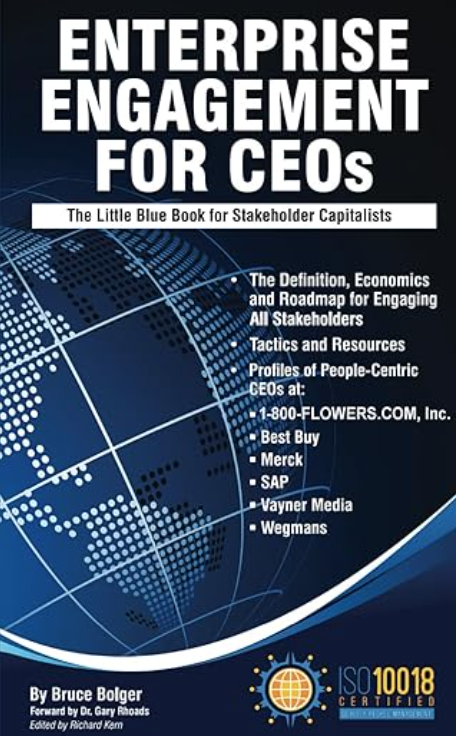
3. Books on implementation: Enterprise Engagement for CEOs and Enterprise Engagement: The Roadmap.
4. Advisory services and research: Strategic guidance, learning and certification on stakeholder management, measurement, metrics, and corporate sustainability reporting.
5. Permission-based targeted business development to identify and build relationships with the people most likely to buy.
6. Public speaking and meeting facilitation on stakeholder management. The world’s leading speakers on all aspects of stakeholder management across the enterprise.