

IRR Research...The Alpha of Appreciation...Channel Insights...IRF 2026 Plans
Click here to subscribe to RRN weekly, and here for an RRN media kit.
Appreciation Can Enhance Share Price Performance
Research: When Do Incentives Work in Channels of Distribution
IRF Announces 2026 Plans
Appreciation Can Enhance Share Price Performance 
Companies that treat their people well outperform in the equity market; not because of higher pay or shinier perks, but because of the intrinsic motivators that shape how people show up for work every day. That’s the key finding of the work of Irrational Capital, as reported by Bart Houlahan, Partner, in a recent Enterprise Engagement Alliance YouTube show: The Human Capital Factor: Turning People Metrics into Durable Alpha for Investors and Companies.
Drawing on more than 20 years of employee survey data across 70,000 companies (750 million data points), Irrational Capital isolates the Human Capital Factor from signals like pride, recognition, purpose/vision alignment, trust, and transparency. The result isn’t a feel-good narrative; it’s a tradable edge, he says. In replications spanning 14 consecutive years, portfolios tilted toward high intrinsic motivation outperformed by roughly four percentage points annually, across sectors and company sizes. (See ESM: The Holy Grail of Investing and HR? New Solution Connects Human Capital to Return on Equity.)
Three points stand out, he says.
- Recognition and appreciation top the list of value drivers. For five years running, the single most powerful predictor Houlahan sees is whether employees feel appreciated and recognized.
- Extrinsic rewards are hygienic. Pay and benefits matter as table stakes; they’re just not what moves motivation—or markets—over time.
- It takes a holistic approach. Extrinsic rewards keep people from leaving; intrinsic motivators make them win. When you manage recognition, purpose, trust, and manager quality as operating metrics, you don’t just get a better culture—you get lower risk, higher multiples, and durable alpha.
When employees feel recognized, aligned to purpose, and well led by their managers, they produce more, innovate more, stay longer, and deliver steadier customer experiences, Houlahan explains. This improves revenue quality and margin durability and—crucially for valuation—reduces company-specific risk.
Houlahan is a steward on leadership in the EEA's Strategic Management Forum for Leaders, Academics, and Investors, which produces ongoing live and recorded shows summarized in articles for ESM and RRN media and the library.
Research: When Do Incentives Work in Channels of Distribution 
Incentives don’t always work just because they’re offered, this study emphasizes. Their success depends on how they’re perceived and whether they make sense in the business environment. The takeaway for managers is that incentives should be designed with the partner’s perspective and market conditions in mind—not just with the company’s own goals.
That’s the key finding of this 2013 academic study published in the Journal of Marketing: When Do Incentives Work in Channels of Distribution. Authors are David I. Gilliland, now Professor Emeritus of Marketing of Colorado State University and Stephen K. Kim, Iowa State University).
This study looks at why incentives—such as bonuses, discounts, or special rewards—sometimes fail to motivate business partners in the intended manner. The authors call this the incentive dilemma. The research focuses on business relationships between companies, like a manufacturer (the principal) and a distributor or reseller (the agent).
 Gilliland and Kim argue that whether an incentive program works depends on how the receiving company views it. They identify two main ways that partners evaluate an incentive:
1. Instrumental evaluation – how much the incentive helps the company’s bottom line or business results.
2. Congruence evaluation – whether the incentive fits with the company’s own goals and strategies.
To test their ideas, the researchers gathered information from 57 in-depth interviews and 386 survey responses in the information technology and brewing industries.
The findings show that incentives are most effective when the partner company sees them as both financially worthwhile and aligned with its own strategy. In those cases, companies are more likely to cooperate closely and actively support the goals of the firm offering the incentive.
On the other hand, the study also finds that context matters. In industries with high volatility—where markets or technologies change quickly—some of the expected positive effects of incentives can backfire. In other words, the same incentive that works well in a stable environment can have negative effects during periods of uncertainty. The level of dependence between the two companies (how much one relies on the other) also affects how incentives are received.
IRF Announces 2026 Research Agenda
The Incentive Research Foundation 2026 agenda will focus on the strategy, design, and metrics that power effective incentive, recognition, and rewards programs, according to the announcement.
“The IRF Research Committee and Board of Trustees have put together a robust 2026 research agenda that will deliver useful data and practical insights to incentive, business, and human resources professionals throughout the year,” says Stephanie Harris, IRF President. “We look forward to sharing this research in white papers, webinars, and at industry events. Our research will also continue to be the cornerstone of our own IRF events, including the IRF Invitational, IRF Leadership Insights Forum, and IRF European Thought Leader Summit.”
The IRF will release the following research studies in 2026:
- January: The IRF 2026 Trends Report
- March: What Top Performing European Companies Do Differently
- April: Using Incentives to Drive Pipeline
- May: Measuring Incentive Program Effectiveness
- June: Maximizing CVB Value for Incentives
- July: Participant Preferences: Reward & Recognition Programs
- September: Impact of Incentives on Training, Learning and Certification
- October: 2026 Incentive Travel Index, in partnership with SITE
- December: Industry Outlook for 2027: Merchandise, Gift Cards and Event Gifting
Enterprise Engagement Alliance Services
Celebrating our 15th year, the Enterprise Engagement Alliance helps organizations enhance performance through:
1. Information and marketing opportunities on stakeholder management and total rewards:
ESM Weekly on stakeholder management since 2009; click here for a media kit.
RRN Weekly on total rewards since 1996; click here for a EEA YouTube channel on enterprise engagement, human capital, and total rewards insights and how-to information since 2020.
2. Learning: Purpose Leadership and Stakeholder
 Management Academy to enhance future equity value and performance for your organization.
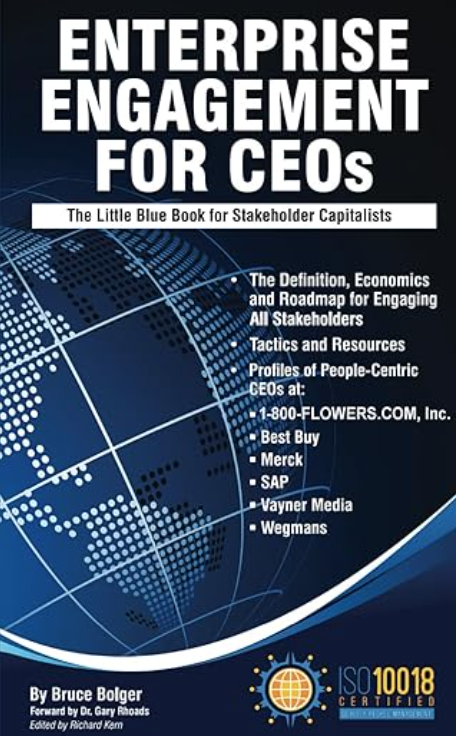
3. Books on implementation: Enterprise Engagement for CEOs and Enterprise Engagement: The Roadmap.
4. Advisory services and research: Strategic guidance, learning and certification on stakeholder management, measurement, metrics, and corporate sustainability reporting.
5. Permission-based targeted business development to identify and build relationships with the people most likely to buy.
6. Public speaking and meeting facilitation on stakeholder management. The world’s leading speakers on all aspects of stakeholder management across the enterprise.