

Incentive Research Foundation Study: How to Retain Incentive Momentum
 Here’s the latest in an ongoing series of reports translating academic research into practical reports for management.
 Click here to subscribe to RRN weekly, and here for an RRN media kit.
This recent Incentive Research Foundation study by Research Director Allan Schweyer, Academic Research in Action: Incentive Fatique—Why Rewards Lose Steam and How to Fix Them, addresses incentive fatigue — the natural erosion of motivation when rewards become too frequent, predictable, or disconnected from what truly matters to employees. This compilation of research provies practical, evidence-based design tactics that can extend an incentive program’s power and sustain engagement over time.
According to the study, to build programs that endure, leaders should:
- Reward progress, not just performance.
- Keep structures simple, fair, and transparent.
- Use cash for frequency and tangible rewards for moments that matter.
- Foster trust and recognition that connect individual success to shared purpose.
- Communicate thoughtfully — enough to motivate, not enough to overwhelm.
Incentive and recognition programs often start strong — but over time, enthusiasm fades. Participation drops, performance gains plateau, and rewards that once excited participants begin to feel routine.
Across studies, the central message is clear: the most effective programs are balanced, transparent, and psychologically engaging. Here’s a summary of insights from multiple studies.
1. Combat Habituation with Selectivity and Variety
One of the strongest findings across multiple studies is that people quickly get used to frequent, low-impact rewards. The IRF study notes that overexposure reduces novelty and excitement — a process known as habituation. Frequent tangible rewards lose their luster, while infrequent but meaningful moments retain emotional value.
Recommendation: Use cash for ongoing, frequent reinforcement (e.g., daily or weekly metrics), but reserve tangible or non-cash rewards for special milestones or standout performance moments. Variety also matters: rotate reward types and offer choice to reignite interest.
2. Simplify Incentive Mechanics to Avoid “Overstacking”
Programs often fail when participants can’t easily understand how to win. Research suggests that too many mechanics — points, tiers, badges, drawings — create noise and distract from the goal. Clarity drives motivation.
Recommendation: Choose one primary incentive path directly tied to a key business outcome. Simplicity increases trust, comprehension, and motivation. Participants should immediately know what action is rewarded and why.
3. Link Rewards to Skill Growth and Value Creation
A well-designed incentive should not just encourage effort — it should encourage improvement. Research shows that when programs are connected to learning or skill development, motivation lasts longer because participants perceive a sense of progress and mastery.
Recommendation. Tie incentives to measurable learning milestones that affect business metrics — such as certification completions linked to productivity or sales growth. Progress-based rewards, rather than one-off bonuses, keep engagement high by connecting effort to development.
4. Leverage Streak-Based Rewards to Sustain Persistence
This new research provides one of the most promising findings for combatting incentive fatigue. Streak-based (progressive or tiered) rewards — those that escalate with consecutive completions of a task — significantly increase persistence. Participants push harder not because the reward is bigger, but because they’ve invested prior effort and don’t want to “break the streak.”
Recommendations:
- Design programs around consecutive successes (e.g., “three in a row” goals).
- Frame progress visually, emphasizing the continuity of achievement.
- Use small, escalating incentives that increase with streak length. Even minimal increases can outperform static rewards.
- Test streak designs carefully to avoid discouragement if streaks feel unattainable.
5. Gamification Can Spark Interest — When Used Wisely
Game-based elements — such as leaderboards, storylines, and progress bars — can make repetitive work more engaging. However, their impact depends on context, Schweyer warns. When intrinsic motivation is low or traditional financial incentives are weak, gamification boosts participation. But when strong financial rewards already exist, adding game features can dilute motivation.
Recommendations:
- Use gamification to sustain engagement in low-stakes or repetitive tasks.
- Match the game element to the motivational gap: use competition when drive is low, and storylines to enhance meaning.
- Avoid layering games over strong cash incentives; this can backfire and reduce focus on outcomes.
Based on a 2025 global employee engagement study of 25,000+ participants.
Recognition and fairness were found to be the two strongest predictors of engagement. Employees disengage quickly when programs feel biased, arbitrary, or opaque — even when rewards are generous. Transparent criteria, clear communication, and authentic recognition prevent fatigue and build lasting trust.
Recommendations:
- Publish simple, public rules and transparent scoring.
- Pair every tangible reward with visible, sincere recognition.
- Empower leaders to connect recognition with purpose — linking effort to company values or mission.
- Avoid excessive competition, which can foster disengagement and burnout.
7. Optimize Communication Frequency to Avoid “Ping Fatigue”
This study, though focused on crowdfunding, offers a parallel lesson for incentive program communications: more is not always better. The relationship between update frequency and engagement follows an inverted U-shape — too few updates cause apathy, too many can cause overload.
Actionable insights:
- Find the “sweet spot” — roughly one to two concise, meaningful updates per month for year-long campaigns.
- Use visuals and short summaries to show progress without overwhelming detail.
- Track open rates and feedback to adjust frequency dynamically.
- Set communication expectations upfront so participants know when to expect updates.
Conclusion: Designing for Endurance, Not Excitement
The IRF’s research underscores a powerful truth: the best incentive programs are not just exciting at launch — they are sustainable by design.
To build programs that endure, leaders should:
- Reward progress, not just performance.
- Keep structures simple, fair, and transparent.
- Use cash for frequency and tangible rewards for moments that matter.
- Foster trust and recognition that connect individual success to shared purpose.
- Communicate thoughtfully — enough to motivate, not enough to overwhelm.
Enterprise Engagement Alliance Services
Celebrating our 15th year, the Enterprise Engagement Alliance helps organizations enhance performance through:
1. Information and marketing opportunities on stakeholder management and total rewards:
ESM Weekly on stakeholder management since 2009; click here for a media kit.
RRN Weekly on total rewards since 1996; click here for a EEA YouTube channel on enterprise engagement, human capital, and total rewards insights and how-to information since 2020.
2. Learning: Purpose Leadership and Stakeholder
 Management Academy to enhance future equity value and performance for your organization.
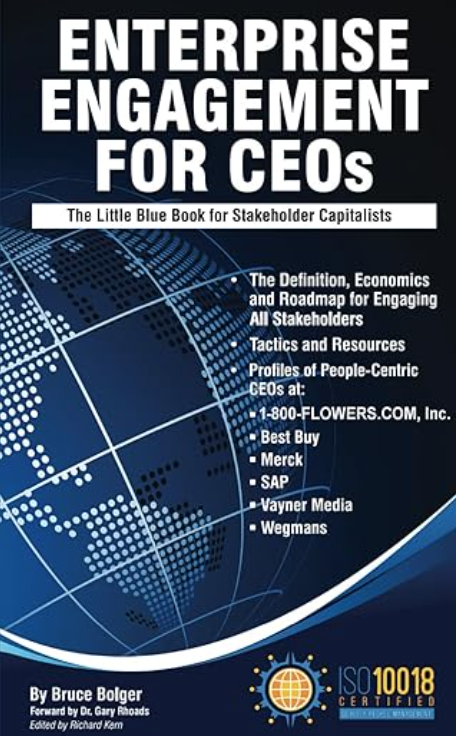
3. Books on implementation: Enterprise Engagement for CEOs and Enterprise Engagement: The Roadmap.
4. Advisory services and research: Strategic guidance, learning and certification on stakeholder management, measurement, metrics, and corporate sustainability reporting.
5. Permission-based targeted business development to identify and build relationships with the people most likely to buy.
6. Public speaking and meeting facilitation on stakeholder management. The world’s leading speakers on all aspects of stakeholder management across the enterprise.