

Incentive Travel Spending Rises as Experiences Take Priority and Gifting Faces Cuts
Spending Increases, But Buyers Remain Cautious
Shared Experiences Gain Importance
Business Impact Is a Priority, But the Study Does Not Establish ROI
Event Gifting Faces Pressure—and Selective Investment
Risk Reshapes Destination Decisions
Methodology and sponsors
Click here to subscribe to the ESM weekly e-newsletter.
Incentive travel spending is increasing, but buyers are becoming more selective about where the money goes. The 2026 Incentive Travel Index (ITI) reports that average spending per person reached $5,500 in 2026, up 7.8% from $5,100 in 2025, while most buyers expect participation levels to remain broadly unchanged in 2027.
The findings point to an industry balancing higher costs with pressure to deliver memorable experiences and support business objectives. Shared cultural activities and dining are gaining importance. Gifting remains the most frequently targeted reduction among buyers planning cuts, although some buyers upgrading programs are investing more in gifts.
The October 2026 report is a collaboration between the Incentive Research Foundation (IRF) and SITE Foundation, with Oxford Economics as research partner.
The research used an online survey fielded globally from May through July 2026, with questions customized for corporate end users, incentive travel agencies, destination management companies, destination marketing organizations, and destination suppliers. It included 2,017 respondents across 83 countries, with 861 buyers spanning 19 industry verticals. Buyers represented 42.7% of respondents, sellers 53.9%, and other roles 3.4%. Question-level samples vary substantially, so individual findings should be interpreted using their stated response bases. The highlights report does not specify a probability sampling design, response rate, weighting procedure, or margin of error.
Spending Increases, But Buyers Remain Cautious
 Higher spending does not translate into widespread plans to expand programs. Only 28.2% of buyers expect incentive travel activity, measured by the number of people, to exceed 2026 levels in 2027. That rises to 39.4% for 2028. For 2027, 52.1% of buyers expect per-person budgets to match inflation, while 30.7% plan to trim programs and 17.2% plan improvements. The outlook improves for 2028, when 32.1% anticipate improvements and 19.0% expect cuts.
North American buyers report the highest 2026 spending, averaging $6,100 per person, compared with $4,900 in both Western Europe and Asia-Pacific. Hotels and airfare account for 46.5% of projected 2027 budgets, with food and beverage adding another 20.5%.
These figures suggest that suppliers must demonstrate how their offerings contribute to program quality within budgets already dominated by major travel and hospitality costs.
Shared Experiences Gain Importance
The study provides clear evidence of an increased emphasis on experiences. Group cultural and sightseeing experiences were identified as important to program success by 71.1% of respondents, up from 60.0% in 2025. Group dining increased from 58.0% to 66.0%.
Among buyers planning to improve their 2027 programs, 59.8% intend to upgrade activities and 57.3% accommodations. Improvements to food and beverage and gifting each attract 40.2%. These buyers are more likely to invest in what happens at the destination than in longer stays or more distant travel.
Experience quality also appears to matter more than destination prestige alone: 61.7% of respondents agree that a well-designed program in a secondary domestic city can outperform an underwhelming program in an iconic international destination.
The findings do not support eliminating individual choice or downtime. Buyers place substantially more importance on free time than sellers do—64% versus 42.4%. Only 39.9% of buyers say destination selection is highly aligned with qualifiers’ own preferences; 56.8% describe partial alignment, with logistics, cost, and corporate priorities often taking precedence.
The report also distinguishes between experiences that motivate, create memories, and provide meaning. Beach and sunshine destinations lead on motivation, adventure travel leads on memorability, and international travel leads on meaning. International travel is the only category appearing among the top three on all three measures.
Business Impact Is a Priority, But the Study Does Not Establish ROI
The ITI identifies business objectives and perceptions of experience value, but does not provide a measured return on investment or demonstrate that incentive travel caused improvements in business performance.
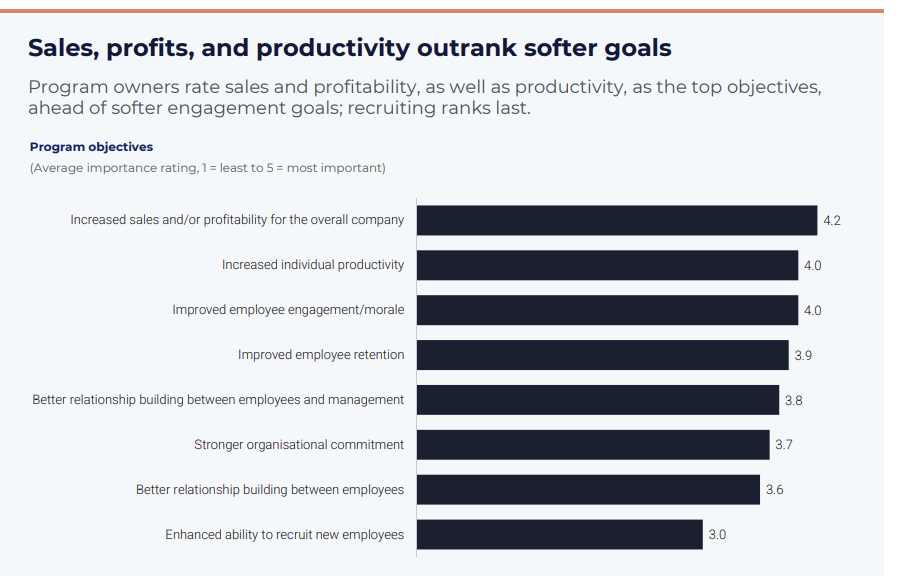
Among 115 corporate end-user respondents, increased company sales and profitability rank as the leading program objective, scoring 4.2 out of five. Individual productivity and employee engagement or morale each score 4.0, followed by retention at 3.9. The study’s motivational, memorable, and meaningful experience ratings are buyers’ assessments, rather than direct measurements collected from qualifiers. They should therefore be read as industry perceptions of effectiveness.
There is nevertheless a strong call to communicate value: 76.2% of respondents agree that educating the next generation of corporate HR and finance leaders about what incentive travel delivers is the industry’s best investment. For program owners, the implication is to connect experience design with defined business goals and evaluate results. That is an interpretation of the findings, rather than evidence that the survey establishes financial impact.
The report also highlights skepticism about environmental impact claims: 51% agree with a statement characterizing most incentive travel sustainability commitments as greenwashing and measurable environmental progress as the exception.
Event Gifting Faces Pressure—and Selective Investment
Gifting presents one of the study’s sharpest contrasts. Among 148 buyers planning to trim program quality in 2027, 55.4% identify reduced gifting as a cost-saving measure, up from 44.7% in the previous survey. It remains the most common reduction, ahead of choosing a less expensive destination at 47.3% and shortening trips at 39.9%.
That 55.4% figure applies specifically to buyers planning cuts, not to all buyers. Conversely, among 82 buyers planning improvements, 40.2% intend to improve gifting, up from 34.2% in 2025. Gifting accounts for an average 4.5% of projected 2027 program budgets.
For gifting providers, the findings suggest a need to explain how gifts contribute to recognition and the participant experience. The study does not examine preferred gift categories, recipient reactions, or gifting’s independent effect on business results.
Risk Reshapes Destination Decisions
Geopolitical instability is disrupting destinations used by 60.5% of buyers, while 83.3% report changing booking behavior in response to geopolitical sentiment during the previous 12 months. Western Europe has the strongest net momentum for future destination use, followed by Emerging Europe and the Caribbean. These figures represent intentions to increase use minus intentions to decrease use, rather than confirmed bookings. AI is also becoming part of planning: the report finds that 60.8% use it for at least three applications. However, only 24.4% agree that companies using AI are already more successful at designing personalized, cost-effective, logistically optimized programs.
Methodology and sponsors
Sponsors are:
- Champion: Accor, Bishop-McCann, Destination Canada, Hilton, and ITA Group.
- Prime: Florida COTC Corporate Events and Gift Card Market.
- Principal: IMEX and W Florence.
Enterprise Engagement Alliance Services
 Celebrating our 17th year, the Enterprise Engagement Alliance helps organizations enhance performance through:
1. Information and marketing opportunities on stakeholder management and total rewards:
- ESM Weekly on stakeholder management since 2009. Click here to subscribe; click here for media kit.
- RRN Weekly on total rewards since 1996. Click here to subscribe; click here for media kit.
- EEA YouTube channel on enterprise engagement, human capital, and total rewards since 2020
 Management Academy to enhance future equity value for your organization.
3. Books on implementation: Enterprise Engagement for CEOs and Enterprise Engagement: The Roadmap.
4. Advisory services and research: Strategic guidance, learning and certification on stakeholder management, measurement, metrics, and corporate sustainability reporting.
5. Permission-based targeted business development to identify and build relationships with the people most likely to buy.
Contact: Bruce Bolger at TheICEE.org; 914-591-7600, ext. 230.