.jpg)

Merits Next Chapter: Building the Infrastructure of Engagement from the Middle East to the World
From Gifting to Global Infrastructure
The COVID Inflection Point
Engagement as a System, Not a Program
The Hidden Advantage: Program Design
The Next Leap: A DIY Enterprise Platform
Building a Federation, Not Just a Company
Preparing for an IPO
Why Barbier Believes Merit is Winning
A Broader Mission
Click here to subscribe to RRN weekly, and here for an RRN media kit.
.jpeg) In a category long defined by fragmented tools, legacy thinking, and misunderstood value, Merit Incentives intends to redraw the map of what engagement means for modern enterprises in the Middle East. Under the leadership of Founder and CEO Julie Barbier, originally from France, the company has evolved from a regional gifting business into a global engagement infrastructure platform, with ambitions that stretch beyond traditional loyalty or rewards programs.
In a category long defined by fragmented tools, legacy thinking, and misunderstood value, Merit Incentives intends to redraw the map of what engagement means for modern enterprises in the Middle East. Under the leadership of Founder and CEO Julie Barbier, originally from France, the company has evolved from a regional gifting business into a global engagement infrastructure platform, with ambitions that stretch beyond traditional loyalty or rewards programs.Now operating across 160 countries, fresh off a Series B funding round, and actively preparing for a future IPO, Merit represents what it believes is the future of the industry: a scalable, data-driven, and design-led approach to engagement that connects customers, employees, and partners in one ecosystem.
During this war, concern for the safety of employees is a daily priority today, says Barbier, adding that the people in the regional have a high level of resilience and commitment to their work so that business opportunities proceed.
From Gifting to Global Infrastructure
Merit’s origin story is deceptively simple. What began as a B2C digital gifting platform in Dubai became something much larger when multinational clients started asking for help with rewards and incentives in the Middle East, Barbier recounts. That demand exposed a gap. “It wasn’t just about rewards,” Barbier explains. “There was a real opportunity to build an engagement technology platform.” That insight led to the 2016 launch of Merit—a pivot that would position the company early in a market that was largely underserved and misunderstood.
Timing mattered. So did geography. As Saudi Arabia and the broader region opened up economically and culturally, Merit was already on the ground, able to localize solutions, meet regulatory requirements like in-country cloud hosting, and build trust with regional enterprises, Today, Saudi Arabia generates roughly half of the company’s revenue, with Riyadh emerging as a strategic hub for global growth.
The COVID Inflection Point
If Merit’s early success was about timing, its global expansion was accelerated by necessity. Covid-19 forced organizations—especially in the Middle East—to rapidly digitize engagement strategies that had traditionally been physical and relationship-driven. Merit was uniquely positioned to respond. “We grew from about 10–15 countries to 160 countries,” says Barbier. “Everything went digital overnight.”
Airlines needed new ways to enable mileage redemption. Banks and global companies needed scalable engagement tools for distributed, multicultural workforces. Governments and institutions accelerated digital adoption at unprecedented speed. In a region where 70% of the population is under 30, the shift wasn’t just accepted—it was a requirement, she explains.
Engagement as a System, Not a Program 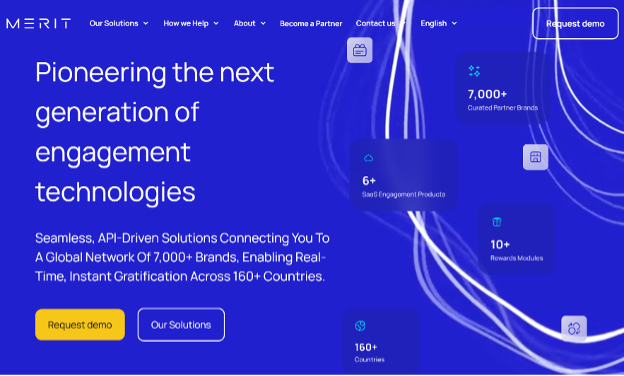
At the core of Merit’s philosophy is a fundamental reframing of engagement. Rather than treating loyalty, employee engagement, and incentives as separate silos, Merit approaches them as interconnected levers within a broader system. “We don’t think about a client as just customer loyalty or just employee engagement,” Barbier says. “We provide a holistic approach to engage all stakeholders.”
This perspective has shaped both the company’s product and its growth strategy. Merit is not positioning itself as another SaaS platform layered on top of existing complexity. Instead, it is building what Barbier describes as “engagement as a service”—a global infrastructure that enables organizations to design, deploy, and scale engagement programs dynamically. The analogy is deliberate: just as fintech transformed banking through “banking-as-a-service,” Merit is aiming to do the same for engagement.
The Hidden Advantage: Program Design
One of Merit’s most important—and often overlooked—differentiators is its emphasis on program design, Barbier emphasizes. In many markets, particularly the US, engagement initiatives fail not because of technology, but because they are poorly designed, disconnected from business objectives, or based on incomplete data. Barbier saw this early. “When we started, no one knew what employee engagement really meant,” she says. “We had to educate the market.”
That necessity forced Merit to build deep consulting and client success capabilities alongside its technology. Today, that DNA remains central to its approach. Rather than simply delivering rewards or running campaigns, Merit works closely with organizations to understand behaviors, goals, and cultural context—then designs programs that drive measurable outcomes. “Engagement is about change,” Barbier explains. “You want people to repeat behaviors you value, or change behaviors you don’t.”
The Next Leap: A DIY Enterprise Platform
After years of rapid growth—12x in the last three years, she reports—Merit is now entering its next phase: democratization of its platform. The company is preparing to launch a self-service (DIY) engagement platform, designed to bring enterprise-grade capabilities to a much broader market, including SMBs.
This shift is significant.
Historically, engagement solutions have been expensive, complex, and difficult to scale—especially for smaller organizations. Merit’s new platform, she says, aims to change that by combining:
- Unified engagement tools across stakeholders
- Real-time data and dashboards
- AI-driven insights and automation
- Global redemption capabilities (gift cards, merchandise, experiences)
Building a Federation, Not Just a Company 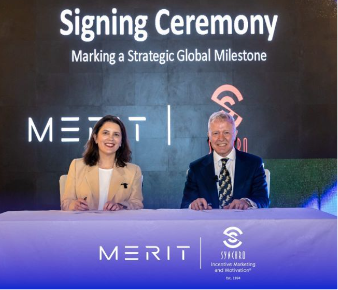
While many companies in the industry have pursued growth through traditional acquisitions, Merit is taking a different path. Barbier envisions a “federation of entrepreneurs”—a network of regional players, partners, and specialists connected through Merit’s infrastructure. “We don’t want to acquire and just pile up numbers,” she says. “We want people to join us and build something meaningful.” This model allows Merit to scale globally while maintaining local expertise—a critical advantage in a category where culture, regulation, and consumer behavior vary widely. Recent moves, including expansion into Europe, Australia, and the US., reflect this strategy. Merit recently acquired Syncho Marketing in Australia, a channel engagement company.
Despite its global footprint, Merit has approached the US market cautiously. The opportunity is clear: a large but fragmented market, with many legacy players and increasing demand for data-driven engagement solutions. But Barbier is deliberate about timing. “It’s a very big market, and it requires capital,” she notes. “We want to enter at the right moment.” That moment may align with the company’s broader financial roadmap.
Preparing for an IPO
Merit, Barbier reports, has begun positioning itself for an eventual IPO. While not yet at the listing stage, the company is actively preparing—building the operational, financial, and technological foundation required for public markets. This includes:
- Scaling global infrastructure
- Expanding product capabilities
- Strengthening data and AI integration
- Entering new geographies strategically
Why Barbier Believes Merit is Winning
Several factors underpin Merit’s rapid rise, she says.
1. Early-mover advantage in emerging markets. Entering the Middle East early allowed Merit to grow alongside a rapidly modernizing economy.
2. Localization with global scale. The ability to operate within local regulatory frameworks while delivering global solutions.
3. Holistic engagement philosophy. Breaking down silos between customer, employee, and partner engagement.
4. Program design expertise. Combining consulting, data, and technology to drive real outcomes.
5. Infrastructure thinking. Positioning engagement as a foundational business system—not a standalone tool.
6. Timing and adaptability. Capitalizing on digital transformation trends accelerated by COVID and AI.
A Broader Mission
Beyond growth and technology, Barbier’s vision is rooted in impact. “I want to build something that creates real value,” she says. “For clients, for teams, for society.” That perspective reflects a broader shift in how engagement is being understood—not as a tactical function, but as a strategic driver of performance, culture, and resilience.
Five years from now, Barbier sees Merit as:
- A truly global company
- A leading engagement infrastructure provider
- A platform connecting a federation of industry players
- A public company scaling innovation across markets
Enterprise Engagement Alliance Services
Celebrating our 15th year, the Enterprise Engagement Alliance helps organizations enhance performance through:
1. Information and marketing opportunities on stakeholder management and total rewards:
ESM Weekly on stakeholder management since 2009; click here for a media kit.
RRN Weekly on total rewards since 1996; click here for a EEA YouTube channel on enterprise engagement, human capital, and total rewards insights and how-to information since 2020.
2. Learning: Purpose Leadership and Stakeholder
 Management Academy to enhance future equity value and performance for your organization.
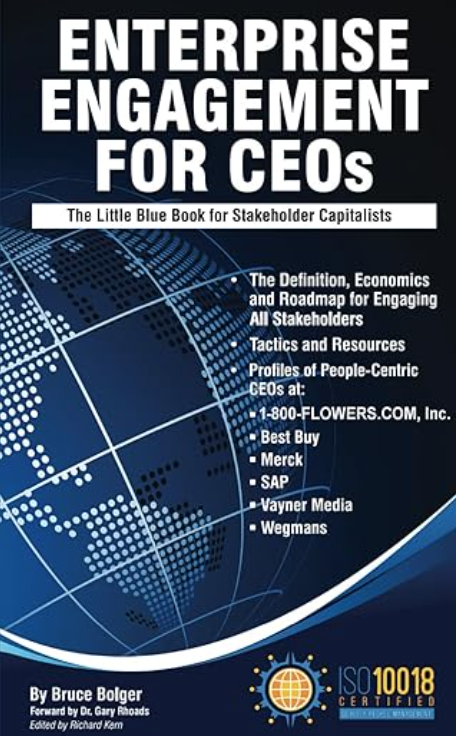
3. Books on implementation: Enterprise Engagement for CEOs and Enterprise Engagement: The Roadmap.
4. Advisory services and research: Strategic guidance, learning and certification on stakeholder management, measurement, metrics, and corporate sustainability reporting.
5. Permission-based targeted business development to identify and build relationships with the people most likely to buy.
6. Public speaking and meeting facilitation on stakeholder management. The world’s leading speakers on all aspects of stakeholder management across the enterprise.