

Pulse Experiential Travel Joins Patagonia, Salesforce in Using CSRD Model for Sustainability Reporting
.png) Founded in 1979 and probably the earliest provider of individual incentive travel programs, Pulse Experiential Travel achieves another first in the IRR industry: it publishes one of the first US corporate sustainability reports using a framework consistent with the European Union Corporate Sustainability Reporting Directive.
Founded in 1979 and probably the earliest provider of individual incentive travel programs, Pulse Experiential Travel achieves another first in the IRR industry: it publishes one of the first US corporate sustainability reports using a framework consistent with the European Union Corporate Sustainability Reporting Directive. Purpose of Following EU CSRD Guidelines
How Pulse Report Aligns With EU CSRD
Click here to subscribe to RRN weekly, and here for an RRN media kit.
What does Pulse Experiential Travel have in common with Patagonia and Salesforce? It publishes its first annual corporate sustainability report consistent with the double-materiality and stakeholder reporting framework of the EU Corporate Sustainability Reporting Directive. Featuring no photos or marketing speak, it provides all stakeholders with a plain-spoken disclosure of its purpose, goals, objectives and values and the opportunities and risks it creates for all stakeholders and the environment.
Click here for the Pulse 2025 Corporate Sustainability Report.
While Manassas, VA-based Pulse Experiential Travel is not legally subject to the EU Corporate Sustainability Reporting Directive (CSRD), which requires 83 metrics many irrelevant to a company of its size and none disclosed by its competitors, its 2025 Corporate Sustainability Report is intentionally structured to follow the spirit and core principles of the CSRD—particularly its emphasis on purpose-driven governance, double-materiality, stakeholder impacts, risk and opportunity management, and independent verification, according to Marc Matthews, Founder and CEO.
The report was created by the Tarrytown-NY based Enterprise Engagement Alliance’s Corporate Sustainability Reporting group. It was independently audited by Darwin Hanson, President of the compensation and human capital reporting firm TM Evolution and CEO of the International Center for Enterprise Engagement, Brainerd, MN, a specialist in human capital design and impact measurement.
Purpose of Following EU CSRD Guidelines
According to Matthews, “Even though we have built sustainability into every experience we sell, we didn’t wish to publish another glossy corporate sustainability report. Instead, recognizing that many of our corporate clients may ultimately be influenced by the global spread of the EU’s Corporate Sustainability Reporting Directive (CSRD), we decided to follow that framework and went to the only US organization we knew of experienced in creating such a report for a company our size. I think most will agree that this report goes way beyond the type of corporate sustainability reports most companies in the US publish today, providing a level of transparency that I hope will make it easier for all our stakeholders to do business with us and vice versa.
Although Pulse is not legally obligated to comply with the CSRD, “we have intentionally structured this sustainability report to reflect the directive’s spirit and underlying principles. This includes transparent disclosure of purpose, policies, and values; the systematic use of double-materiality to examine risks and opportunities for all stakeholders; presentation of qualitative and quantitative metrics; and independent third-party verification of key information. By adopting these elements, we aim to support comparability, credibility, and trust across our stakeholder community while remaining appropriate for a privately held US-based organization, none of whose competitors yet provide this level of information."
According to Bruce Bolger, Founder of the Enterprise Engagement Alliance which produced the report, "the purpose of using the CSRD format is to move away corporate sustainability reports as a marketing tool and rather as a comparable, transparent way to evaluate how Pulse conducts business in order to enhance alignment with the interests of its customers, employees, distribution and supply chain partners, communities, and the environment."
While the EU debates the final company size threshold for formal disclosures, it likely will only apply to organizations with more than 1,500 employees in the EU.
How the Pulse Report Aligns With EU CSRD
The specific disclosures under the law are known as the European Sustainability Reporting Standards (ESRS.) The Pulse report follows the ESRS outline in the disclosure of it purpose, goals, objectives, risks and opportunities, strategies to address them and metrics used to measure improvement.
A. CSRD Principle: Companies must disclose business model, strategy, governance, stakeholder engagement, and sustainability policies.
Pulse Alignment:
- Clear business description and purpose
- Governance structure (family-owned, roles, audit review)
- Purpose, values, and strategic orientation toward stakeholder value
- Detailed stakeholder-specific sections (Customers, Employees, Suppliers, etc.)
- Risk and opportunity disclosures for each stakeholder group
- High transparency about processes (concierge model, surveys, quality control)
CSRD Principle: Identify:
- Impacts on people/environment
- Sustainability risks/opportunities affecting financial performance
- Opportunities created by Pulse
- Risks created by Pulse
- Risks external factors create for Pulse
- How Pulse addresses those risks
C. ESRS S1 – Own Workforce.
Pulse alignment:
- Hybrid/remote work model
- Strong benefits, above living wage
- Zero voluntary turnover
- Health, dental, retirement, paid leave
- Training, culture, and AI-integration support
D. ESRS S2/S3 – Workers in the Value Chain and Affected Communities
Pulse alignment:
- Description of supplier relationships
- Supplier performance monitoring
- Rapid replacement of poor-performing suppliers
- Support of global MICE (meetings, incentives, conventions, exhibitions) community
- Contributions to industry education foundations (Incentive Research Foundation, Society for Incentive Travel Excellece, Incentive Marketing Association.)
Pulse alignment:
- Concierge system for end-user experience
- Approval and sign-off for all itineraries
- 24/7 support
- Extensive communication controls and customer relationship oversight
- Post-trip surveys and quality control
F. ESRS E1–E5 – Environmental Standards
- Pulse is not required nor able to calculate emissions or provide standardized ESRS environmental metrics, but it addresses environmental considerations in a manner consistent with CSRD’s spirit:
- Acknowledgement of travel-related environmental impacts
- Offsets embedded in every program; because offsets are provided in the form of donations to third-party environmental causes, Pulse cannot disclose the specific level of environmental mitigation
- Support for UN-vetted environmental causes
- Paperless operating system reducing footprint
- Promotion of sustainable tourism in rural/underserved areas
Enterprise Engagement Alliance Services
Celebrating our 15th year, the Enterprise Engagement Alliance helps organizations enhance performance through:
1. Information and marketing opportunities on stakeholder management and total rewards:
ESM Weekly on stakeholder management since 2009; click here for a media kit.
RRN Weekly on total rewards since 1996; click here for a EEA YouTube channel on enterprise engagement, human capital, and total rewards insights and how-to information since 2020.
2. Learning: Purpose Leadership and Stakeholder
 Management Academy to enhance future equity value and performance for your organization.
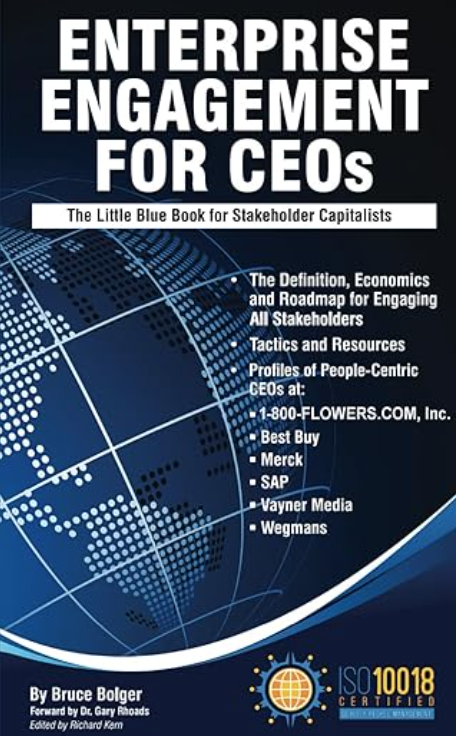
3. Books on implementation: Enterprise Engagement for CEOs and Enterprise Engagement: The Roadmap.
4. Advisory services and research: Strategic guidance, learning and certification on stakeholder management, measurement, metrics, and corporate sustainability reporting.
5. Permission-based targeted business development to identify and build relationships with the people most likely to buy.
6. Public speaking and meeting facilitation on stakeholder management. The world’s leading speakers on all aspects of stakeholder management across the enterprise.