

RRN Research Brief: A Meta Analysis of Three Studies on Recognition
Why Peer to Peer Recognition Can Backfire
A 2020 Meta Analysis of Incentives and Recognition by CIPD
Study From India Linking Recognition and Job Satisfaction
A consistent theme runs across three recent research efforts: recognition and incentives can lift performance and satisfaction—but design details and
 perceived fairness determine whether the impact is positive, neutral, or negative.
Click here to subscribe to RRN weekly, and here for an RRN media kit.
Key takeaways include:
- Design choices matter as much as budget (public feeds/leaderboards vs. private delivery; meaningful vs. performative recognition).
- Fairness and governance are the multipliers—they determine whether incentives motivate or demotivate.
- Recognition strategy should be measured like any other performance lever (pre/post checks, segmentation, feature testing).
- Peer-to-peer recognition can backfire when it’s made “public” in ways that trigger social comparison. One study found employees felt less appreciated after rollout of a public peer recognition system; experimental follow-ups point to public feeds and leaderboards as features that can reduce average feelings of appreciation by encouraging unhealthy comparison.
- Financial incentives generally improve performance, and the popular “rewards always kill intrinsic motivation” claim doesn’t hold as a universal rule. The CIPD evidence review reports overall positive performance effects and finds no generalizable “crowding out” effect—though perceived unfairness/exploitation is a key risk factor.
- Non-monetary recognition often drives longer-lasting morale benefits than money alone, and customization matters (timely, meaningful recognition aligned to what employees value). A recent mixed-methods study reports stronger long-term morale effects from non-monetary approaches such as public praise and personalized feedback than from monetary incentives.
Why Peer to Peer Recognition Can Backfire
The study: When Being Recognized Makes Employees Feel Less Appreciated: Evidence Regarding When and Why Peer-to-Peer Recognition Could Backfire (2004).
Authors: Paul W. Black, Professor Harbert College of Business, Auburn University; Mark S. Cecchini, Andrew H. Newman, Professors at the Darla Moore School of Business, University of South Carolina.
Key findings (business implications)
- After a company (unnamed in the study) implemented a public peer recognition system, employees reported feeling less appreciated by peers, contrary to leadership expectations.
- In experiments, public feeds and leaderboards drove different types of social comparison and produced incremental negative effects on average feelings of appreciation—even though peer recognition in isolation tends to increase appreciation.
- Practical implication: recognition platforms aren’t “set and forget.” Interface features (feed visibility, ranking, comparisons) can determine whether recognition becomes motivating or demoralizing.
- Field surveys at a company pre- and post-rollout of a public peer recognition system.
- Controlled experiments including a 2 times 3 design manipulating recognition amount (low/high) and format (private/public/public and leaderboard), plus a supplemental experiment described in the research paper.
A 2020 Meta Analysis of Incentives and Recognition by CIPD
The study: Incentives and Recognition: An Evidence Review. (2022) — CIPD (United Kingdom Chartered Institute for Personnel and Development).
Authors. Charles Cotton, Senior Policy Advisor; Jonny Gifford, Principal Fellow and Jake Young, Senior Advisor CIPD), based on two rapid evidence assessments conducted by Eric Barends, Emilia Wietrak, and Denise Rousseau (Center for Evidence-Based Management).
Key findings and business implications
- The analysis of existing research focuses on two core questions: (1) how financial incentives affect motivation/performance, and (2) what effects non-financial recognition has.
- It reports that financial incentives have a strong body of research supporting improved performance, and that the “incentives generally erode intrinsic motivation” claim is not supported as a generalizable effect (with important exceptions tied to perceived unfairness/exploitation).
- It also defines recognition as personal, non-monetary, often unexpected and relational, and treats recognition as a legitimate performance lever (not merely “nice to have”).
Study From India Linking Recognition and Job Satisfaction
Exploring the Relationship Between Employee Recognition and Job Satisfaction (2025)
Published in the International Journal of Global Research Innovations and Technology.
Author. Vidushi Shukla, MBA candidate, School of Business, Galgotias University, Greater Noida, Uttar Pradesh, India.
Key findings:
- Consistent and meaningful recognition is associated with higher job satisfaction.
- Monetary incentives contribute more to short-term motivation, while non-monetary recognition (public praise, personalized feedback, team acknowledgments) shows a stronger long-term impact on morale.
- The paper recommends customized recognition strategies, more peer recognition, and integrating recognition into core values—i.e., to “systematize it,” not just occasional gestures.
- Sample includes employees across diverse industries/roles/levels; reported sample size includes 50 employees with stratified random sampling.
Enterprise Engagement Alliance Services
Celebrating our 15th year, the Enterprise Engagement Alliance helps organizations enhance performance through:
1. Information and marketing opportunities on stakeholder management and total rewards:
ESM Weekly on stakeholder management since 2009; click here for a media kit.
RRN Weekly on total rewards since 1996; click here for a EEA YouTube channel on enterprise engagement, human capital, and total rewards insights and how-to information since 2020.
2. Learning: Purpose Leadership and Stakeholder
 Management Academy to enhance future equity value and performance for your organization.
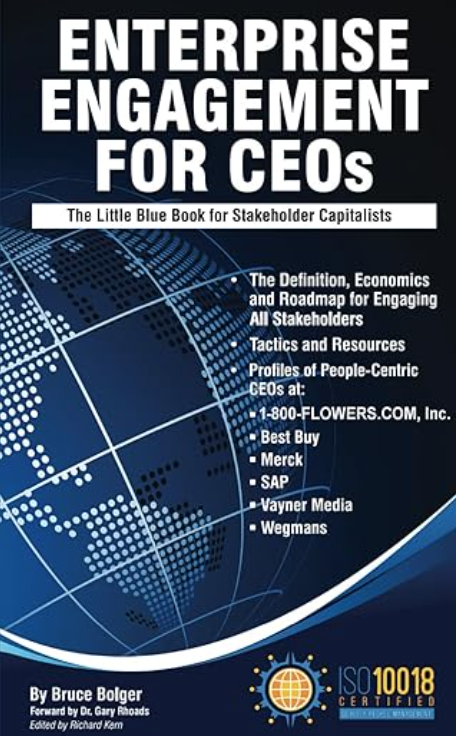
3. Books on implementation: Enterprise Engagement for CEOs and Enterprise Engagement: The Roadmap.
4. Advisory services and research: Strategic guidance, learning and certification on stakeholder management, measurement, metrics, and corporate sustainability reporting.
5. Permission-based targeted business development to identify and build relationships with the people most likely to buy.
6. Public speaking and meeting facilitation on stakeholder management. The world’s leading speakers on all aspects of stakeholder management across the enterprise.