

Recognition Isnt Enough: The New Standard for Employee Engagement Providers Is Measurable Impact
.jpeg) As recognition companies move into employee engagement or start using the term with greater frequency in their marketing, they are stepping into a far more demanding arena—one defined not by programs, but by performance systems. To compete credibly, they must demonstrate deep expertise in behavior-based program design, cross-functional alignment, multiple engagement tactics, advanced analytics, and continuous improvement frameworks that connect engagement directly to business outcomes.
As recognition companies move into employee engagement or start using the term with greater frequency in their marketing, they are stepping into a far more demanding arena—one defined not by programs, but by performance systems. To compete credibly, they must demonstrate deep expertise in behavior-based program design, cross-functional alignment, multiple engagement tactics, advanced analytics, and continuous improvement frameworks that connect engagement directly to business outcomes.By Darwin Hanson
Hanson is Chief Human Capital Analytics Advisor to the Enterprise Engagement Alliance and Founder, CEO of TM Evolution, a compensation and human capital analytics firm, and CEO of the International Center for Enterprise Engagement impact analytics and reporting firm.
From Programs to Progress: Demonstrating Expertise in Behavioral Design
From Silos to Systems: Aligning Strategy, Execution, and Stakeholders
From Activity to Impact: Advanced Analytics, Continuous Improvement, and Measurable Value
Click here to subscribe to RRN weekly, and here for an RRN media kit.
The shift from recognition to employee engagement is not a simple extension of services—it is a fundamental repositioning from delivering experiences to engineering performance. Recognition, while important, is only one mechanism within a broader system required to influence behavior and results. Decades of work in enterprise engagement in total quality management underscore a consistent pattern: value is created only when organizations align people, processes, and incentives around measurable objectives. As a result, companies entering this space must demonstrate far more than program delivery capabilities. They must show that they can design for progress, integrate multiple engagement levers, and continuously measure and optimize their impact on performance.
As recognition companies move into employee engagement, they are entering a space defined by accountability for results. Success will depend on their ability to demonstrate rigorous expertise in behavioral design, systems alignment, and advanced analytics—supported by continuous improvement processes that drive measurable impact. Recognition may open the door, but only those who can build and sustain performance systems will earn a lasting role.
Click here to take a free anonymous test to benchmark your own abilities to foster the proactive involvement of your organization, teams, customers, or distribution partners.
From Programs to Progress: Demonstrating Expertise in Behavioral Design
What distinguishes a true engagement partner is the ability to design systems that drive sustained behavior change—not just launch initiatives. This requires a level of discipline and specificity that goes well beyond traditional recognition programs. At a minimum, firms must demonstrate the ability to:
- Translate business objectives into critical behaviors. For example, linking growth goals to frontline actions such as cross-selling, service responsiveness, or safety compliance.
- Segment audiences and personalize engagement strategies. Different roles, geographies, and performance levels require different approaches—not one-size-fits-all programs.
- Design reinforcement architectures. This includes the intentional use of recognition, incentives, feedback, coaching, and communications in coordinated ways that reinforce desired behaviors over time.
- Map the full engagement journey. From onboarding to ongoing performance, including key moments that influence motivation, alignment, and retention.
- Embed engagement into workflow. Ensuring that engagement mechanisms are not “extra” activities but integrated into how work actually gets done.
From Silos to Systems: Aligning Strategy, Execution, and Stakeholders .png)
Engagement only works when multiple elements of the organization are aligned. Companies must therefore demonstrate systems thinking—the ability to connect strategy to execution across functions and stakeholders. This includes the capability to:
- Integrate multiple engagement levers. Align recognition, incentives, learning, communications, performance management, and leadership practices into a single coherent strategy.
- Ensure goal alignment from enterprise to individual. Clear line of sight so employees understand how their actions contribute to organizational objectives.
- Enable managers as primary drivers of engagement. Providing tools, training, and data that allow managers to reinforce behaviors consistently.
- Coordinate across functions. HR, operations, marketing, and finance must all support the same engagement objectives rather than operate in silos.
- Incorporate a stakeholder approach. Recognizing that employee behavior is influenced by customers, partners and leadership—and designing systems that align all of them.
From Activity to Impact: Advanced Analytics, Continuous Improvement, and Measurable Value
Perhaps the most critical—and most difficult—capability is proving impact. Engagement companies must move beyond reporting activity to demonstrating contributions to business performance. That requires expertise in three tightly connected areas:
1. Measurement Architecture
- Defining leading indicators (e.g., participation in key behaviors, manager interactions) and lagging indicators (e.g., productivity, retention, revenue).
- Establishing baselines and benchmarks to track progress over time.
- Creating clear hypotheses about how engagement initiatives drive outcomes.
- Moving from descriptive metrics to diagnostic and predictive analytics—understanding not just what happened, but why and what will happen next.
- Using segmentation analysis to identify which populations are responding and where gaps exist.
- Applying correlation and, where possible, causal modeling to link engagement efforts to business results.
- Delivering actionable dashboards that managers and leaders can use in real time.
- Implementing test-and-learn methodologies (e.g., pilot programs, A/B testing of incentives or communications).
- Creating closed-loop feedback systems that incorporate employee input, performance data, and manager insights.
- Regularly refining program design based on evidence, not assumptions.
- Establishing governance processes to review outcomes, adjust strategies, and scale what works.
An engagement program designer should consider such psychological principles as:
- Present bias—the preference for immediacy in rewards.
- Loss aversion---people feel the loss of something more strongly than the gains.
- Hedonic adaption—the reduced impact of rewards as people get used to them.
- Social comparison—the judgement of rewards against what other receive.
- Mental accounting—the role experiences, merchandise, and other awards can play in mental accounting.
Enterprise Engagement Alliance Services
Celebrating our 15th year, the Enterprise Engagement Alliance helps organizations enhance performance through:
1. Information and marketing opportunities on stakeholder management and total rewards:
ESM Weekly on stakeholder management since 2009; click here for a media kit.
RRN Weekly on total rewards since 1996; click here for a EEA YouTube channel on enterprise engagement, human capital, and total rewards insights and how-to information since 2020.
2. Learning: Purpose Leadership and Stakeholder
 Management Academy to enhance future equity value and performance for your organization.
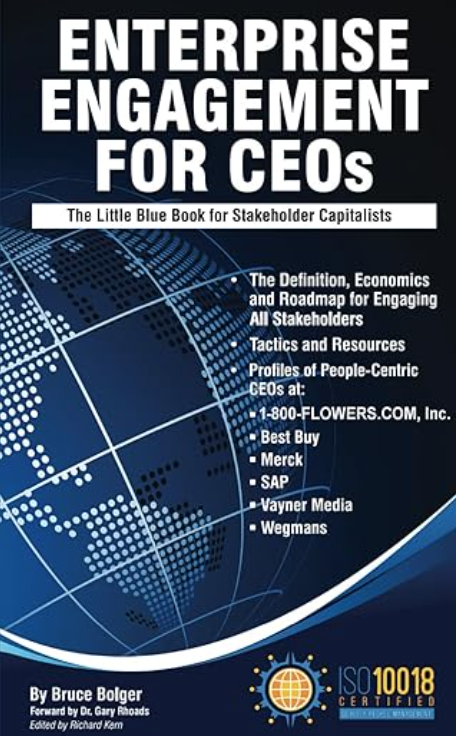
3. Books on implementation: Enterprise Engagement for CEOs and Enterprise Engagement: The Roadmap.
4. Advisory services and research: Strategic guidance, learning and certification on stakeholder management, measurement, metrics, and corporate sustainability reporting.
5. Permission-based targeted business development to identify and build relationships with the people most likely to buy.
6. Public speaking and meeting facilitation on stakeholder management. The world’s leading speakers on all aspects of stakeholder management across the enterprise.