
.jpg)

Recognition's Bright Shiny Object: A Moment of Reckoning for Private Equity
 Here’s how the private equity world has slowly undermined recognition and what can be done about it.
 By Gary Rhoads, EEA Chief Academic Advisor
How Recognition Became a Bright Shiny Object
Why the Bloom Is Off the Rose For Recognition
Click here to subscribe to RRN weekly, and here for an RRN media kit.
When venture capital and then private equity entered the recognition industry in the dot-com era and 2000s, it wasn’t hard to see the appeal. Cloud-based platforms. Recurring SaaS revenue. Digital catalogs. Social feeds. Points and badges. Recognition looked modern, scalable, and—perhaps most importantly—sexy. Capital followed the shine.
And yet, more than twenty years later, there is not a single defining venture capital or private equity success story that has transformationally reshaped how organizations create value through recognition. That reality deserves reflection—not blame, but a focus on why and what to do about it.
Curiously, venture capital and private equity has been far less involved in the incentive industry than in recognition and the related businesses of gifting. Incentives—when they are carefully structured performance-based programs tied directly to measurable outcomes—have often delivered clearer ROI stories. But incentives are less flashy, sometimes almost controversial. They lack the sleek tech narrative. They require disciplined performance metrics and operational alignment. They are about results more than technology and rewards alone, and many companies mistakenly believe they can plan these motivational programs on their own, even though few receive any training in what is essentially a form of behavioral economics.
How Recognition Became a Bright Shiny Object
.jpg) Recognition, by contrast, was the bright shiny object. Founders and operators understandably leaned into the story investors wanted to hear: scalable platforms and rewards ecosystems could drive engagement at scale. Technology plus social recognition and gifts would unlock performance. Subscription models and fulfillment margins would generate attractive returns. It was a clean growth thesis. It sounded a lot like customer relationship management, only the investors ironically overlooked a critical people element: program design and impact measurement, without which the technology has little value.
Recognition, by contrast, was the bright shiny object. Founders and operators understandably leaned into the story investors wanted to hear: scalable platforms and rewards ecosystems could drive engagement at scale. Technology plus social recognition and gifts would unlock performance. Subscription models and fulfillment margins would generate attractive returns. It was a clean growth thesis. It sounded a lot like customer relationship management, only the investors ironically overlooked a critical people element: program design and impact measurement, without which the technology has little value.The difficulty is that technology and rewards, by themselves, have never been proven to produce sustained, measurable improvements in productivity, quality, retention, or recruitment. Software can make recognition easier. Rewards can reinforce appreciation. But neither replaces the hard work of aligning people and management practices with business performance. The same goes for customer relationship management technology—it is of little value unless customized to an organization’s work flow and operating system and backed up with continual training and communication.
The CRM field dealt with this by enabling the creation of a vast community of CRM implementers, independent businesspeople engaged with all the professional services related to the technology. The world of recognition never built this concept of distribution into their business models.
In many cases, recognition solutions were sold at the executive level as strategic, then delegated to mid-level decision-makers with limited training in engagement science. Vendor choices were often made based on platform aesthetics, user interface, or reward selection and pricing rather than on documented performance impact. For a time, that was enough. Recognition was seen as progressive. Adoption itself signaled cultural commitment. The technology made giving recognition and gifts more efficient, but there is little proof that this translates into bottom line value creation or enhanced employee well-being. The leading proponents continue to repeat the same statistics about the connection between recognition and turnover, but literally none that I know of have published independently audited or research impact metrics.
As human capital analytics have advanced, and CFO scrutiny has intensified, a tougher question has emerged: Where is the measurable value? When providers have suggested deeper integration—professional services, consulting, behavior-change design, performance measuremen--to their private equity investors, they have reportedly encountered resistance in off-the-record conversations. The investor preference has been clear: SaaS fees and rewards margins are scalable. The trouble is that almost 30 years focused on this approach have not yielded the desired results.
Consulting is not as easily packaged, and there remains little proof that companies will pay for professional services to enhance engagement when most organizations have little knowledge of how to connect engagement with financial or other tangible results. Engagement has never been a plug-and-play technology problem. It is a systems challenge that blends leadership, metrics, job design, culture, and effective impact measurement. Since when does selling more points or social wall recognition create enterprise value?
There is little evidence that these recognition firms have invested in development of clear return-on-investment measurement metrics or found a scalable model for selling through capable resellers as is common in CRM. All of their validation stories rely on association or industry studies, rather than their own verifiable case studles. There are tens of thousands of CRM implementers based on the attendance at Saleforce’s Dreamforce, not to mention the annual conferences of all the other leading providers. There no more than several dozen incentive, recognition, and loyalty companies in the US.
Why the Bloom Is Off the Rose for Recognition
Recognition and gifting platforms are a dime a dozen, some offering what many companies can find at retail, and many companies don’t value them. Many either refuse to pay per-seat fees for usage or only the bare minimum, versus much higher fees for CRM. Differentiation is fading. Buyers are more sophisticated. The market is no longer impressed by features alone.
This moment is not a crisis for the industry—it is an opportunity.
Private equity understands value creation better than most. The discipline of linking investment to measurable return is precisely what the recognition field now needs. The next chapter should not be just be about shinier platforms or larger reward catalogs. It should be about measurable business impact. That means shifting the focus from:
- Features to program design and serious performance metrics.
- Rewards volume to measurable productivity and quality gains.
- Engagement surveys to dollar-denominated or other tangible outcomes, including estimates for future equity value creation.
- Technology as strategy to technology as enabler.
In short, they could make recognition less about being sexy and more about being substantive.
There has never been a greater need to unlock value through people. Organizations are under pressure to do more with less. Talent markets remain competitive. Productivity growth is elusive. AI will not take off as quickly as a useful tool unless properly enabled by people.
Engagement is not a perk—it is a performance lever. Private equity was drawn to recognition by its shine. The real opportunity now lies in its substance. The bright shiny object had its moment. It’s time to focus on value creation.
Enterprise Engagement Alliance Services
Celebrating our 15th year, the Enterprise Engagement Alliance helps organizations enhance performance through:
1. Information and marketing opportunities on stakeholder management and total rewards:
ESM Weekly on stakeholder management since 2009; click here for a media kit.
RRN Weekly on total rewards since 1996; click here for a EEA YouTube channel on enterprise engagement, human capital, and total rewards insights and how-to information since 2020.
2. Learning: Purpose Leadership and Stakeholder
 Management Academy to enhance future equity value and performance for your organization.
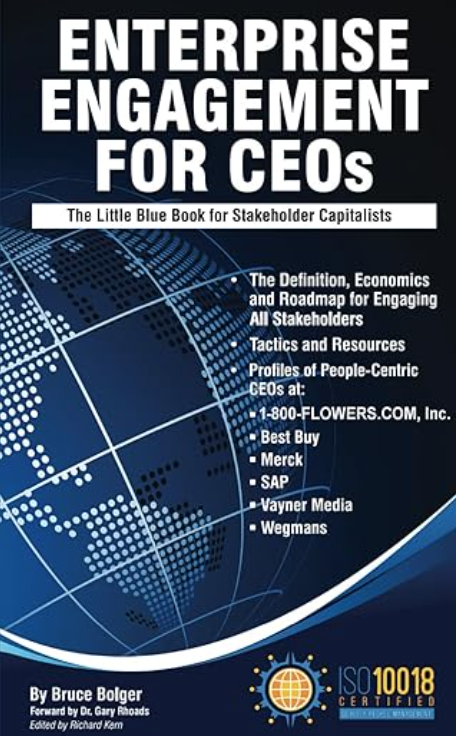
3. Books on implementation: Enterprise Engagement for CEOs and Enterprise Engagement: The Roadmap.
4. Advisory services and research: Strategic guidance, learning and certification on stakeholder management, measurement, metrics, and corporate sustainability reporting.
5. Permission-based targeted business development to identify and build relationships with the people most likely to buy.
6. Public speaking and meeting facilitation on stakeholder management. The world’s leading speakers on all aspects of stakeholder management across the enterprise.