.jpg)

Starbucks Puts Deloittes Loyalty Research to the Test And Reveals Where Strategy Meets Reality
 As Deloitte’s latest loyalty research warns that traditional rewards programs are losing relevance, Starbucks is rolling out a redesigned rewards strategy that both validates—and challenges—the report’s core findings. As the Starbucks loyalty program overview demonstrates, the program is anything but simple for anyone except for those who already care.
 Deloitte: More Emphasis on Experiences, Personalization, and Simplicity
The Case for Simplicity
Click here to subscribe to RRN weekly, and here for an RRN media kit.
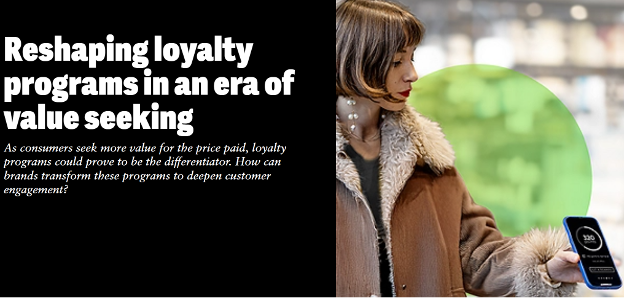
Deloitte’s recent insight study, Reshaping Customer Loyalty Programs, argues that loyalty today must be personalized, experiential, and simple to sustain engagement. Starbucks’ newly revamped rewards program embraces much of that vision through tiered benefits, digital personalization, and experiential perks, while simultaneously exposing the risks Deloitte highlights around complexity, accessibility, and everyday participation.
The recent Deloitte report on loyalty arrives at a pivotal moment for Starbucks, as the company introduces a major update to its Starbucks rewards program at a time when it has finally shown signs of recovering from a period of little to negative growth. Together, the research and the Starbucks strategy offer a revealing look at where modern loyalty programs are headed—and where even best-in-class brands risk overengineering the experience.
Loyalty programs are undergoing a fundamental transformation as brands rethink how they reward, engage, and retain customers, according to Deloitte Insights. It says that traditional points-based programs are no longer sufficient to sustain long-term engagement, as consumers increasingly expect personalized, flexible, and meaningful value from the brands they frequent. It also raises the question--what are the qualifications and training of the people who design these programs, since the practices are taught nowhere in schools. See ESM: Why a Widely Used Discipline Has So Few Qualified Experts and Why That Should Concern Business Leaders.
Deloitte’s research finds that while consumers are enrolled in numerous loyalty programs, they actively engage with only a small fraction of them. The issue is not awareness, but relevance. Price, quality, and convenience remain the top drivers of brand choice, but loyalty programs rank close behind—72% of consumers say such programs influence their likelihood to spend more with a brand. Still, Deloitte cautions that enrollment alone does not equal loyalty; engagement must be continuously earned through value that feels immediate, intuitive, and personal.
Deloitte: More Emphasis on Experiences, Personalization, and Simplicity 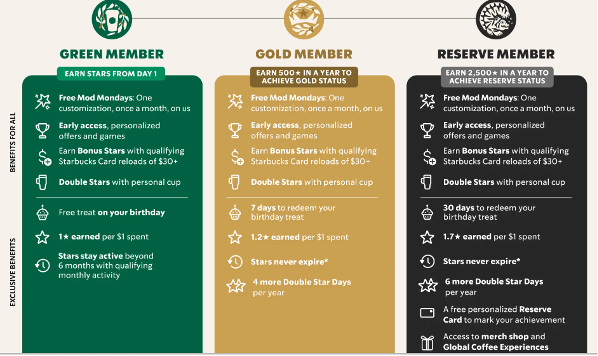
Among the strongest trends Deloitte identifies is a shift away from basic “earn-and-burn” models toward programs that offer experiential rewards, personalization, and digital ease. Consumers—particularly younger ones—expect seamless mobile integration, tailored offers, and benefits that extend beyond discounts or free items.
Starbucks appears to be taking those findings to heart. As reported by Yahoo Finance, the company is rolling out a redesigned Starbucks rewards program built around a tiered structure, with Green, Gold, and Reserve levels designed to reward deeper engagement with increasingly exclusive perks. The updated program is intended to deliver more flexibility, personalization, and perceived value to its more than 35 million US loyalty members; it is also designed to encourage people to stretch to reach the next level.
At the same time, Starbucks has emphasized that its growth is not limited to loyalty members alone. Executives have noted that the company is seeing increased traffic and transactions from customers outside the loyalty ecosystem, signaling a dual strategy: strengthening rewards for high-value customers while keeping the broader brand accessible to casual and non-member guests.
In many respects, Starbucks’ approach appears to align closely with Deloitte’s recommendations. The move toward tiered rewards reflects Deloitte’s emphasis on differentiated value, while expanded redemption options and experiential benefits echo the report’s call for loyalty programs that foster emotional connection, not just transactional behavior. Starbucks’ reliance on its mobile app and customer data further supports Deloitte’s view that digital convenience and personalization are now table stakes.
The Case for Simplicity
However, the comparison also reveals a potential warning to Starbucks. Deloitte stresses the importance of simplicity and ease of engagement, warning that overly complex programs risk alienating customers who want immediate, intuitive value. Starbucks’ tiered system, while attractive to frequent customers, introduces added complexity that could discourage more occasional users—precisely the engagement gap Deloitte flags as a growing industry challenge.
Customer sentiment reflects this risk. Previous changes to Starbucks rewards sparked complaints from customers who felt that benefits were being diluted or made harder to earn. While the company’s latest redesign aims to restore value through new perks and greater flexibility, skepticism remains among some customers who worry that loyalty rewards are becoming more complicated rather than more rewarding, according to the Yahoo Finance report.
The takeaway from both Deloitte’s research and Starbucks’ experience is clear: loyalty programs are no longer optional marketing tools—they are strategic platforms that can either strengthen or strain customer relationships and directly affect sales. As brands invest more heavily in loyalty, success will depend on striking the right balance between rewarding top customers and keeping everyday participation simple and worthwhile.
In the evolving loyalty landscape, the brands that win will be those that make loyalty feel less like a math problem—and more like a genuine value exchange. So the big question is, what are the qualifications of the people who recommend or make these decisions?
Enterprise Engagement Alliance Services
Celebrating our 15th year, the Enterprise Engagement Alliance helps organizations enhance performance through:
1. Information and marketing opportunities on stakeholder management and total rewards:
ESM Weekly on stakeholder management since 2009; click here for a media kit.
RRN Weekly on total rewards since 1996; click here for a EEA YouTube channel on enterprise engagement, human capital, and total rewards insights and how-to information since 2020.
2. Learning: Purpose Leadership and Stakeholder
 Management Academy to enhance future equity value and performance for your organization.
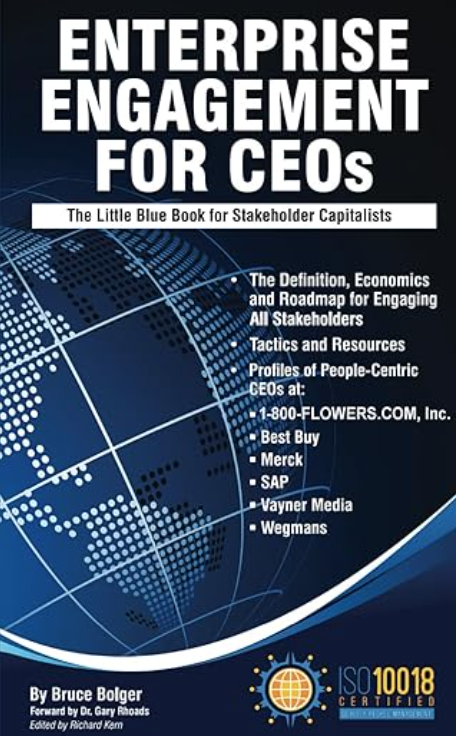
3. Books on implementation: Enterprise Engagement for CEOs and Enterprise Engagement: The Roadmap.
4. Advisory services and research: Strategic guidance, learning and certification on stakeholder management, measurement, metrics, and corporate sustainability reporting.
5. Permission-based targeted business development to identify and build relationships with the people most likely to buy.
6. Public speaking and meeting facilitation on stakeholder management. The world’s leading speakers on all aspects of stakeholder management across the enterprise.