

Why I Call It the Unincentive Company
.jpeg) The founder of this company says he is not trying to disrupt the incentive, rewards, and recognition business—it’s trying to flip the emphasis to performance, metrics, and continuous improvement rather than on reward or recognition products.
The founder of this company says he is not trying to disrupt the incentive, rewards, and recognition business—it’s trying to flip the emphasis to performance, metrics, and continuous improvement rather than on reward or recognition products. By Darwin Hanson, President, International Center for Enterprise Engagement (ICEE) and of TM Evolution
What You Focus On Is What You’ll Get
The Focus on Value Creation, Not New Ways to Deliver Rewards
A Positive and Necessary Disruption
A Useful Parallel: CRM Technology
What Decades of Research Tell Us About Implementation
ICEE’s Role: Integration, Not Aggregation
Click here to subscribe to RRN weekly, and here for an RRN media kit.
When I chose to acquire assets of the International Center for Enterprise Engagement, my newest venture, and describe it as "unincentive company,: it was not because incentives, rewards, and recognition (IRR) lack value. On the contrary, when used correctly, they are powerful tools. The problem is not with IRR and gifting itself, but with how often it is emphasized over—rather than aligned with—the true purpose, goals, and objectives organizations or teams are trying to achieve.
.jpg) ICEE exists to create value for clients by helping them focus on outcomes first and rewards and recognition second. Our model is equally about helping industry solution providers of all types bring meaningful, integrated solutions to market. In both cases, the shift is from selling and buying “things” to designing systems that work together to accomplish goals.
ICEE exists to create value for clients by helping them focus on outcomes first and rewards and recognition second. Our model is equally about helping industry solution providers of all types bring meaningful, integrated solutions to market. In both cases, the shift is from selling and buying “things” to designing systems that work together to accomplish goals. We help organizations achieve strategic and tactical purpose, goals, objectives and values through:
- Objective impact evaluation services based on proven total quality management practices and statistical process controls to correlate outcomes with behaviors backed with a SaaS platform for easy advanced analysis.
- Program design and implementation support based on the same total quality management practices that align purpose, goals, objectives of any effort with training, communications, voice, rewards and recognition or potentially with any issue, such as job design, or innovation, that can affect outcomes--often on a pay-for-performance model.
- Auditing of corporate sustainability reporting consistent with the European Union Corporate Sustainability Reporting Directive.
What You Focus On Is What You’ll Get
If your focus is on incentives, rewards, and recognition, that’s what’ll you’ll get—incentives, rewards, and recognition. After decades in compensation, human capital analytics, and performance improvement, I have learned that talent attraction, retention, and engagement are not transactional challenges. They are strategic, holistic, and systematic endeavors. Organizations that succeed do not ask, “What incentive should we offer?” They ask, “What kind of workplace, setting, or value proposition are we intentionally designing to accomplish what purpose, and how do incentives, rewards, recognition and other factors support that design?”
These are the same questions asked in total quality management when it comes to manufacturing and related processes: how to involve and engage all relevant stakeholders in the purpose, goals, objectives, and values of the quality effort; keep them focused on the purpose, goals, objectives; equip them, and properly reward and recognize them so that they feel authentically appreciated.
Effective IRR and total rewards practices don’t require wholesale redesign or new technologies—they simply better align and measure what most organizations already do to communicate with, train, and engage their stakeholders in the relevant actions. Rather than building entirely new tactics, we focus on what the organization already does and how to better align tactics toward the common purpose, goals, objectives, and values. Because our business model isn't based on selling technology or rewards or recognition, although we offer these services, we can help clients that might already have satisfactory technologies and reward solutions.
The Focus on Value Creation, Not New Ways to Deliver Gifts and Awards
Today, unprecedented research confirms the direct connection between stakeholder engagement and financial results. Our job as a company and as an industry is to help organizations make this connection. I haven't seen one other company in this field cite any meaningful research connecting their processes to concrete results nor even cite any of this recent research in their social media, and I hope to change that. It will become increasingly difficult for investors, owners and business leaders and as a result our industry to ignore the latest evidence:
· The Human Capital Factor, has been verified for the sixth year in a row by the analytics department of J.P. Morgan. The HAPI ETF based on those principles has outperformed the S&P 500 by an average of 4% a year since its inception. The HCF tracks the level to which employees feel appreciated and recognized.
· A new working paper—Workplace Wellbeing and Firm Performance” (Oxford Wellbeing Research Centre, Working Paper 2304)—concludes that companies at which employees report feeling happier, more purposeful, more satisfied, and less stressed perform significantly better on virtually every financial measure studied..
· The JUST Capital ETF large cap fund, managed by Goldman Sachs, is based on companies with high levels of customer, employee, and community engagement. It has returned 14% annually since its inception in 2018 at least as well if not better than the S&P 500 depending on how dividends are calculated.
A Positive and Necessary Disruption
By some estimates, there are more than 300,000 private and public organizations and institutions with revenues of $10 million or more that could benefit from a systematic approach to stakeholder management across the enterprise. No single firm can serve that market alone. Progress will come only through collaboration, shared language, and a collective shift away from emphasizing what is sold toward what is solved and by building a marketplace of implementers such as exists in other technology fields
That is why I call this the “unincentive company.” It is not a rejection of incentives, rewards, or recognition. It is a reframing of their role. It is a call to treat IRR with the same maturity and discipline that organizations already apply to technology, operations, and quality.
When incentives are designed as part of a coherent system—aligned with purpose, strategy, and human needs—they are not diminished. They are finally allowed to do what they were always meant to do: support meaningful, sustainable performance.
A Useful Parallel: CRM Technology
A helpful analogy is Customer Relationship Management (CRM) technology. No organization buys CRM because it wants software. They buy it because they want better customer acquisition, retention, insight, and growth. The technology is merely an enabler.
That is why there is an entire ecosystem of consultants, integrators, data specialists, trainers, and change-management professionals surrounding CRM platforms. Organizations understand that value does not come from owning the tool, but from implementing it correctly, aligning it with strategy, and continuously refining how it is used and engaging people to use it effectively.
This is exactly how incentives, rewards, and recognition should be viewed. Organizations do not need “an incentive program” any more than they need “a CRM system.” They need solutions to clearly define and address business and people challenges. IRR is one of many tools that can help—if it is thoughtfully integrated into leadership practices, job design, communications, technology, and culture.
Whether addressing issues related to sales or non-sales employees, channel and supply chain partners, or any type of stakeholder, the same strategic and systematic approach applies.
What Decades of Research Tell Us About Implementation
Decades of research in total quality management, organizational effectiveness, and human capital analytics show that ad hoc approaches do not produce sustainable results. Optimizing individual components does not optimize the system. Yet many organizations continue to layer disconnected initiatives on top of one another, hoping the next program will fix what the last one did not.
The result is predictable: short-term spikes, long-term frustration, and rising costs without commensurate returns.
The opportunity—and responsibility—of the IRR field is to elevate the conversation. Not to abandon incentives, but to place them where they belong: in service of clearly articulated purpose, goals, and objectives grounded in evidence, and measured as part of a broader system of performance and engagement.
ICEE’s Role: Integration, Not Aggregation
ICEE does not aspire to be a one-stop shop. There is no realistic way for one company to deliver all the engagement-related capabilities modern organizations require under one roof. Nor is that desirable. While ICEE handles all the basic aspects of any type of engagement design, implementation, and impact measurement, it provides managing outsourcing for companies that need facilitation with culture, engagement technology and rewards, and other aspects of engagement.
ICEE is partner and integrator in the market so that clients don't have to pay to cover overhead for services they will never use. We work with worldwide experts in leadership, communications, technology, job design, constructive DEI, rewards, and recognition—helping align their strengths around client-defined outcomes. Founding solution provider partners include:
- Appreciation at Work, founded by Dr. Paul White and now owned by J.C. Hite and William Attaway, providing a team-driven, measurable method for building authentic workplace appreciation and culture. Hite and Attaway are specialists in helping mid-size companies scale.
- TM Evolution. My company provides advisory services for compensation, human capital analytics, and employee stock ownership plans (ESOPs), as well as the PVIC impact measurement software.
- Catalog API provides management software for communications, surveys, social recognition, performance points management, and US domestic and international merchandise, gift cards and individual travel awards. It provides technology to some of the leading companies in the world, including incentive, recognition, and engagement firms.
Enterprise Engagement Alliance Services
Celebrating our 15th year, the Enterprise Engagement Alliance helps organizations enhance performance through:
1. Information and marketing opportunities on stakeholder management and total rewards:
ESM Weekly on stakeholder management since 2009; click here for a media kit.
RRN Weekly on total rewards since 1996; click here for a EEA YouTube channel on enterprise engagement, human capital, and total rewards insights and how-to information since 2020.
2. Learning: Purpose Leadership and Stakeholder
 Management Academy to enhance future equity value and performance for your organization.
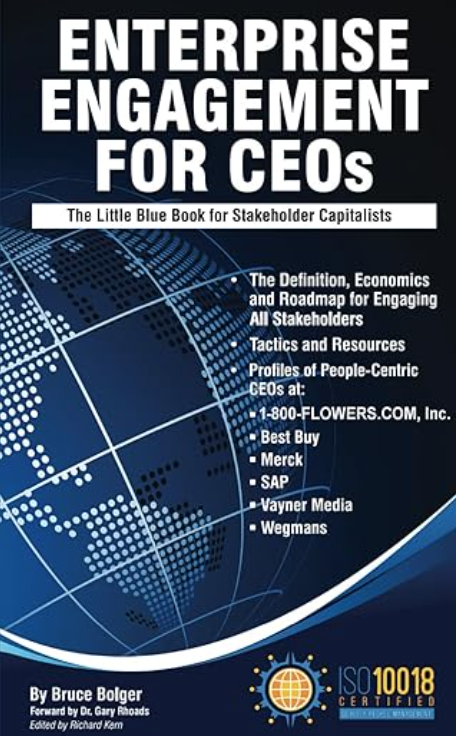
3. Books on implementation: Enterprise Engagement for CEOs and Enterprise Engagement: The Roadmap.
4. Advisory services and research: Strategic guidance, learning and certification on stakeholder management, measurement, metrics, and corporate sustainability reporting.
5. Permission-based targeted business development to identify and build relationships with the people most likely to buy.
6. Public speaking and meeting facilitation on stakeholder management. The world’s leading speakers on all aspects of stakeholder management across the enterprise.