.jpg)

Your Largest Cost Center Has No Operating System
.jpeg) Most organizations are running behavioral engineering programs at scale. They just call them “recognition initiatives.” Almost nobody designing them has any training in behavioral science. Gallup put the price of that global gap at $8.8 trillion in lost productivity annually. That’s not a rounding error. That’s the cost of guessing.
Most organizations are running behavioral engineering programs at scale. They just call them “recognition initiatives.” Almost nobody designing them has any training in behavioral science. Gallup put the price of that global gap at $8.8 trillion in lost productivity annually. That’s not a rounding error. That’s the cost of guessing.By Jason Etter
Etter is Vice President of Growth at WorkProud, a Richardson, TX-based employee engagement and recognition firm.
Engagement Is Not Harmless. It Is Behavioral Engineering
The Data Behind the Design Failure
The Professional Framework That Already Exists
The Missing Links
What Competent Design Actually Produces
The Industry Is Part of the Capability Gap Problem
Click here to subscribe to RRN weekly, and here for an RRN media kit.
 Imagine putting an untrained person in charge of psychological counseling. The harm would be immediate. Obvious. And it would ripple well past the original interaction. Now think about what happens inside most large organizations every single day. Managers get dropped into programs designed to shape how people think, feel, and behave with zero training in behavioral science. Human resources leaders approve incentive structures with no real grounding in what actually motivates people past the short term. Vendors sell engagement platforms and measure success in logins and gift redemptions, not outcomes. And nobody blinks.
Engagement Is Not Harmless. It Is Behavioral Engineering.
Gary Rhoads, Professor Emeritus at BYU’s Marriott School of Business and Academic Director of the Enterprise Engagement Alliance, calls this what it actually is: “engagement programs are mechanisms for influencing human behavior across complex ecosystems.” Built thoughtfully, they create alignment, trust, and sustained performance. Built carelessly, the consequences can be profound.
Wells Fargo is the extreme version; millions of unauthorized customer accounts were created. Not only because of individual bad actors but because of a misaligned incentive system built by people who didn’t fully understand what they were creating. The program shaped behavior at scale. Just the wrong behavior. That mechanism isn’t unique to Wells Fargo. Programs producing outcomes their designers never intended is the documented state of workforce engagement across most organizations running programs today. The stakes are just usually quieter, because so few programs are in fact effectively tracked.
Only 21% of employees globally are engaged, according to Gallup. That $8.8 trillion worldwide annual productivity loss isn’t a motivation problem. The programs exist. They’re just not built by people who know how to build them. That’s the whole thing. Writes Rhoads, “Organizations would never hand financial systems or medical protocols to untrained people. Yet most still let underqualified managers and vendors design systems that shape how their workforce thinks, feels, and acts.”
The Data Behind the Design Failure
The Deloitte 2025 High-Impact Total Rewards research (drawn from more than 700 rewards practitioners and business leaders) gives the clearest picture of what this failure actually costs. Start with 2018. Deloitte found the Net Promoter Score for total rewards among surveyed organizations was negative 15. Their own summary: “rewards just wasn’t rewarding.” This is a function eating cash out of the average organization’s payroll and employee costs, usually the single largest line item on most income statements. And the people it is supposed to serve often dislike it.
By 2024, things had shifted. But unevenly. The lowest maturity tier in total rewards implementation shrank from 53% to 24% of organizations. The highest tier grew from 4% to 18%. Those top performers are the ones actually doing the work: defining behavioral targets, connecting program design to measurable outcomes, holding leadership accountable. They’re now three times more likely to optimize workforce ROI and 15% more likely to retain high performers, according to Deloitte. Not a small delta.
And here’s the number that belongs in a CFO presentation, not an HR update. Irrational Capital's Human Capital Factor research analyzed millions of employee sentiment data points and found that public companies with employees who feel genuinely valued outperform the S&P 500 by approximately 4% annually. Lower drawdowns. Faster earnings growth. Stronger balance sheets. Their conclusion: human capital isn’t priced into traditional financial statements, which means organizations willing to manage it with real discipline have a structural edge. That 4% gap isn’t a culture story. It’s a growth lever.
But 76% of organizations still haven’t crossed that threshold. They have capable platforms. What many lack is the design discipline to use them to produce real outcomes. Finance tracks every dollar in working capital. Operations monitors throughput and defect rates with statistical precision. The function consuming the majority of the P&L? It is still evaluated by activity dashboards that tell leadership almost nothing about whether the investment is working. High maturity organizations are three times more likely to optimize the return of their workforce investment. The other 76% have capable tools in the hands of people who were never trained to use them.
The Professional Framework That Already Exists 
This isn’t a new problem without a solution. It’s an old problem with a solution that human resources hasn’t adopted at scale. Which is both encouraging and a little embarrassing. The ISO 10018 Quality People Management standards apply the same systematic approach to people engagement that ISO 9000 applied to quality management in the 1990s. The standards wre developed specifically because the quality working group recognized that the original standards had left people engagement out of the standards, leading to a lack of continuous improvement. TQM didn’t ask whether quality mattered. It built a discipline: measurable process controls, defined behavioral targets, accountability at every level, continuous improvement cycles. That discipline transformed manufacturing and spread to every serious operational function in the modern organization. The International Center for Enterprise Engagement calls the equivalent for workforce investment TQM for people. The simplest version: run your people investment like you run your supply chain.
And the research backs it up. A recent study on Generation Z workforce productivity finds that incentives alone have no significant direct effect on productivity. Appreciation (non-material acknowledgment that communicates the person is valued, not just their output) had a strong positive impact. The mediating variable was loyalty. Both incentives and appreciation build it, and loyalty is what drives sustained performance. Dr. Paul White, Founder of Appreciation at Work, a culture firm, puts it plainly: “Recognition validates contributions. Appreciation fulfills human needs.” A program built without understanding that distinction isn’t a complete behavioral system. Half of one. The failure also has a manager-level dimension. And it has a name.
The Missing Links
Christopher Littlefield, a recognition practitioner who has trained leaders at organizations from Emirates Airlines to L’Oréal, calls it the Gap Trap. Managers recognize what they can see: the report, the result, the output. They miss everything it actually took to produce it. The person who stayed late, managed a sick kid, absorbed a last-minute scope change, and still delivered. Hand that person a gift card with no acknowledgment of any of that, and it doesn’t feel like recognition. As Littlefield puts it: “Are you kidding me? Is that it?” The program doesn’t fail because the tool was wrong. It failed because the manager was never trained to recognize the right things.
Here’s what’s actually missing from most programs.
First: a clear definition of the specific behaviors the organization is trying to reinforce. Not broad aspirations like “improve culture,” but the precise actions that advance business strategy: customer responsiveness, safety adherence, cross-team collaboration.
Second: program design that actually connect incentives, communication, and leadership behavior to those targets.
Third, and this is where most programs completely fall apart: measurement that belongs in a leadership conversation. Turnover rates. Engagement score movement. Customer satisfaction. Manager effectiveness. Not participation dashboards that nobody outside HR ever opens. Better yet: include an estimate of the cost or benefits of targeted outcomes and behaviors.
What Competent Design Actually Produces
A recent Harvard Business Review analysis of employee ownership programs landed on something that applies directly here: the program alone doesn’t produce the outcome. It only works when organizations reinforce it through management practices, leadership accountability, and measurable targets. The same principle holds across every workforce investment category. Behavioral design is what turns spend into impact. The organizations that have done this right are producing results that belong in a board room, not an HR update. And none of them went shopping for a recognition program.
Nobody wakes up and thinks, “I should buy a recognition platform today.” They have a retention problem; a culture that is fragmenting; a leadership visibility gap that is costing them real money. The tools were part of what solved it.
WalkMe, a digital technology firm, built behavioral reinforcement into its culture framework instead of layering it on top. Peer acknowledgment, leader behavior, service milestones, and onboarding moments were all mapped to the company’s global values. The specific behaviors leadership was actually trying to scale across 12 countries. The result: 96.2% adoption, a 130% increase in eNPS, and internal communication favorability going from 53% to 79%. Not activity metrics. Organizational health indicators.
Gables Residential, a privately held apartment management company, rebuilt from a top-down annual process to a continuous, peer-driven reinforcement system. Annual recognitions went from 140 to more than 11,000. But the number leadership cared about was the 35:1 enterprise-wide ROI alongside roughly a 30% reduction in program costs. It featured better-designed system; people who knew how to connect it to business outcomes. That’s the whole play.
Webster Bank redesigned across 195 branches with one goal: real-time visibility into cultural health before disengagement became attrition. Engagement activity increased 265%. More importantly, leadership could now see which managers were reinforcing performance-aligned behaviors. And which weren’t. That’s the kind of signal that changes management conversations. Not something that lives quietly inside an engagement dashboard.
The Industry Is Part of the Capability Gap Problem
The vendors selling engagement platforms are also part of the problem. Let me be direct about this. The workforce engagement industry (incentives, rewards, the platforms that support them) can’t separate themselves from the capability gap it keeps describing. Vendors who sell engagement platforms without any obligation to ensure their customers understand behavioral design are practicing the same amateur psychology at scale. Powerful behavioral tools. People who were never trained to use them. And success is defined entirely by the activity the tools generate.
When programs are designed without a real understanding of what motivates stakeholders and how they’re connected, the distortions ripple. Short-term activity metrics improve. Long-term loyalty, trust, and performance quietly erode. This isn’t theoretical. It’s the documented state of workforce engagement across the majority of organizations running programs today.
The next stage of this industry won’t be won on platform features, catalog breadth, or mobile experience scores. It’ll be won by vendors who show up to the conversation differently. Not with a demo, with a framework. Not with a participation dashboard, with a behavioral design process that connects program investment to the outcomes leadership already measures and cares about.
The question the research collectively poses is a simple one: are the managers and vendors designing your workforce investment programs equipped to shape behavior responsibly, or are they, however well-intentioned, experimenting on your stakeholders? For a function consuming the majority of the organizational P&L and influencing the behavior of millions of people, “well-intentioned” is not a defense. It’s the problem. And it’s been the problem for a while.
Enterprise Engagement Alliance Services
Celebrating our 15th year, the Enterprise Engagement Alliance helps organizations enhance performance through:
1. Information and marketing opportunities on stakeholder management and total rewards:
ESM Weekly on stakeholder management since 2009; click here for a media kit.
RRN Weekly on total rewards since 1996; click here for a EEA YouTube channel on enterprise engagement, human capital, and total rewards insights and how-to information since 2020.
2. Learning: Purpose Leadership and Stakeholder
 Management Academy to enhance future equity value and performance for your organization.
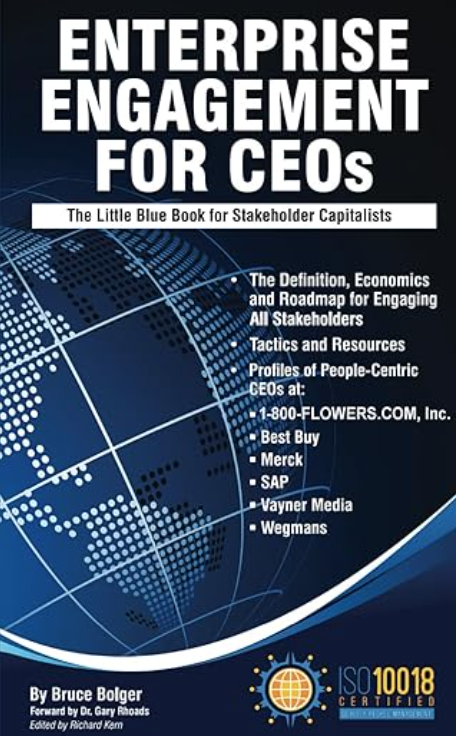
3. Books on implementation: Enterprise Engagement for CEOs and Enterprise Engagement: The Roadmap.
4. Advisory services and research: Strategic guidance, learning and certification on stakeholder management, measurement, metrics, and corporate sustainability reporting.
5. Permission-based targeted business development to identify and build relationships with the people most likely to buy.
6. Public speaking and meeting facilitation on stakeholder management. The world’s leading speakers on all aspects of stakeholder management across the enterprise.